Tradeverifyd Names Amanda Greene Chief Operating Officer to Lead Next Phase of Scale
Former Airbnb and Oyster HR operations leader brings two decades of experience scaling AI-enabled, high-growth companies


Blog >
Compliance & Regulations
The Tradeverifyd Team

With the Global Supply Chain Pressure Index (GSCPI) jumping to 0.68 in March 2026—its highest level in three years—the margin for error in vendor vetting has vanished. For many enterprises, the standard approach has been point-in-time supplier due diligence, a compliance snapshot completed at onboarding and revisited on a fixed schedule.
The problem is that risk doesn’t run on a schedule. The most resilient supply chains are built on real-time intelligence that surfaces procurement risks the moment they emerge. When supply chain data is working for you around the clock, compliance becomes a driver of smarter procurement decisions.
Supplier due diligence is the ongoing process of evaluating a supplier’s financial stability, legal standing, ethical practices, and operational reliability. It gives procurement and compliance teams a clear picture of who they’re doing business with.
The reality is that supply chains are constantly being reshaped. Competitors acquire suppliers, economic pressure erodes financial health, and regulators expand their compliance requirements. A vendor that cleared screening two years ago may carry a significant risk today. Without a system to track those changes, that risk goes undetected.
That visibility is what makes due diligence so valuable at the enterprise level. Reliable, structured supplier data allows teams to allocate resources strategically and make faster decisions when disruptions emerge.

Vetting suppliers once at onboarding and hoping for the best is no longer a viable strategy. The following five steps outline a repeatable workflow that procurement and compliance teams can apply at onboarding and throughout the supplier lifecycle.
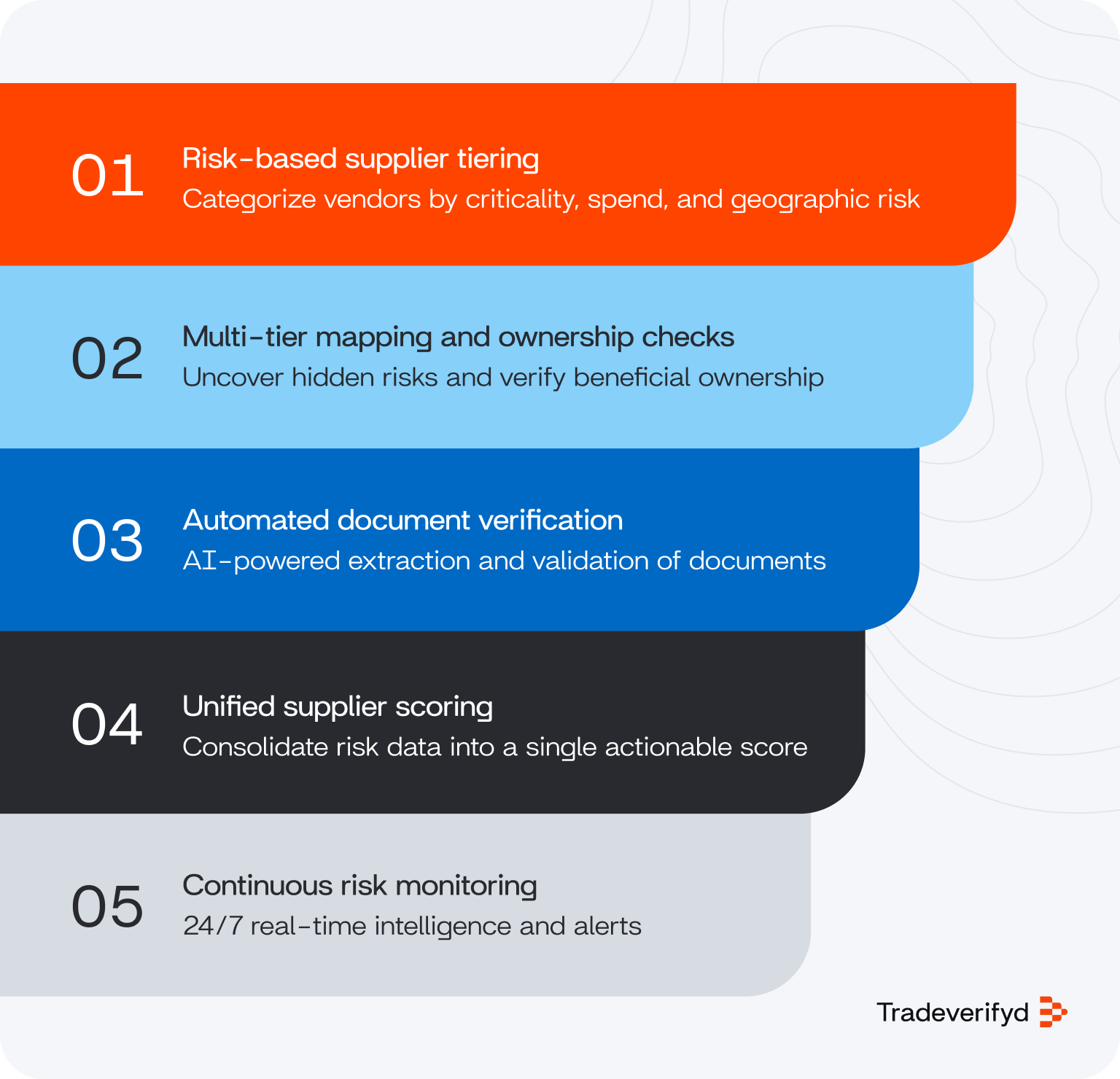
Not all suppliers carry the same weight. Segmenting your base by criticality, spend, and geographic risk allows you to direct the most intensive scrutiny toward your highest-risk relationships. That way, your team isn't spending the same energy on a low-risk domestic vendor as they are on a sole-source manufacturer operating in a volatile region.
Tradeverifyd supports this categorization through its scoring system, surfacing high, moderate, and low-risk levels so teams can prioritize their review efforts accordingly. As your network grows, understanding how supply chain tiers influence risk exposure keeps your process scalable without adding manual overhead.
Risk is often buried deep in your sub-tiers, where you lack direct oversight. Multi-tier mapping reveals the hidden supply chain risks and bottlenecks that surface-level Tier 1 reporting misses. Without this visibility, a disruption three levels down can bring your entire operation to a halt.
Global transparency laws now require verifying Ultimate Beneficial Ownership (UBO), meaning the individuals who ultimately own or control a business. This prevents you from inadvertently partnering with sanctioned entities hidden behind complex corporate layers. Ownership verification capabilities help teams maintain supply chain transparency as corporate structures evolve.
Manual document audits are a primary source of friction and human error. AI-driven tools are transforming how teams handle document verification, automating the ingestion and analysis of critical supplier data.
When documentation is incomplete or inconsistent, supply chain management tools flag it immediately and notify both your team and the supplier, so the issue can be resolved quickly. Your procurement flow keeps moving without waiting for someone to catch the problem.
Fragmented data stalls decision-making. Performing a formal due diligence risk assessment consolidates financial, operational, and ethical metrics into a single supplier score.
To build a high-fidelity score, supply chain risk software aggregates several key inputs:
This scoring gives procurement teams the confidence to move forward, orchestrating automations in areas that make sense, such as a flagged threshold that might prompt a payment hold or a mandatory audit. This framework helps leaders grow strategic partnerships or pivot to alternatives before a crisis hits.
Annual reviews create a dangerous window of exposure. A supplier’s risk profile can change overnight, and a static audit scheduled for next quarter won’t catch it. That’s where supply chain monitoring software earns its place in a modern due diligence program.
Continuous alerts flag changes as they surface across your supplier base. Whether it’s a new sanctions filing, a shift in a supplier’s profile, or an adverse media hit, your team is notified so they can respond before the issue reaches your operations.
That lead time is where continuous monitoring pays off. Knowing about a supplier’s distress before it becomes public gives your procurement team room to secure alternatives before the situation becomes a crisis.
When due diligence runs on automation and real-time data, the benefits compound quickly across your procurement operation. Here’s what that looks like in practice:
A TPRM framework is the enterprise standard for identifying, assessing, and mitigating risk throughout the partnership lifecycle. It establishes the governance needed to navigate the complexities of the procurement chain and maintain a unified compliance posture. Formalizing these protocols helps organizations transform compliance from a burden into a strategic asset, ensuring transparency and resilience across every tier of the global network.
High-risk and business-critical suppliers require continuous monitoring, with formal reviews triggered by material changes such as ownership (UBO) shifts, geopolitical signals, or regulatory updates. Lower-tier vendors typically follow an annual review cycle at a minimum. The optimal cadence ultimately is dictated by your supplier tiering framework.
A background check is a point-in-time verification of fundamental credentials like business registration or sanctions screening. Supplier due diligence is more comprehensive and continuous, evaluating regulatory alignment, operational reliability, and UBO across the entire supplier lifecycle. These two approaches serve distinct roles within a mature supplier risk assessment program.
Enterprises may delegate data collection to third parties, but true resilience requires internal ownership of risk governance. This involves establishing a cross-functional committee to define standardized risk thresholds and escalation protocols.
With this internal framework, your team can immediately act on automated signals, such as rerouting production or initiating holds, rather than stalling for manual approvals during a disruption. This ensures the technology drives action, not just more data.
AI analyzes large volumes of supplier data with greater speed and consistency than manual review. Machine learning models detect patterns across regulatory, legal, and operational data that might remain hidden in a traditional audit, surfacing risk signals earlier and with higher precision.
Industries with heavy regulatory oversight maintain the most stringent due diligence standards. These sectors operate under strict mandates such as the UFLPA, ITAR, and DFARS, which extend directly to their supplier relationships. However, any enterprise managing complex, multi-tier supply chains should adopt this level of rigor to ensure operational resilience and transform compliance into a strategic asset.
Effective supplier due diligence starts long before a disruption forces your hand. The enterprises that manage supply chain risk well have shifted toward continuous, real-time intelligence. When your team has reliable supplier data at all times, better decisions follow naturally across procurement, compliance, and leadership.
Tradeverifyd connects continuous monitoring and automated verification into one platform, giving enterprise teams the tools to stay ahead of supplier risk. Request a demo to see how Tradeverifyd monitors your supplier base continuously to ensure operational resilience and compliance.
Resources & Insights
+
02