Tradeverifyd Names Amanda Greene Chief Operating Officer to Lead Next Phase of Scale
Former Airbnb and Oyster HR operations leader brings two decades of experience scaling AI-enabled, high-growth companies


Blog >
Supply Chain
The Tradeverifyd Team

The "Absorption Wall" is the point at which organizations can no longer absorb tariff-driven cost increases internally and begin passing them to customers. For many supply chains, that threshold is closer than expected.
Changing tariff policy has become one of the most unpredictable cost drivers in global supply chains, forcing organizations to reassess how they manage costs and supplier exposure.
As trade evolves alongside broader geopolitical risks disrupting global supply chains, tariff exposure has become harder to anticipate across multi-tier supplier networks.
Many companies initially shield customers from tariff costs by absorbing them internally, delaying price increases even as tariffs continue to raise landed costs. When they can no longer sustain that buffer, tariff costs begin moving into pricing decisions.
Once companies reach their absorption wall, many begin factoring tariff costs into pricing decisions.
A new survey of 314 U.S. supply chain professionals examines how close organizations are to this tipping point, how they are responding operationally, and whether tariff-driven price increases may soon become more visible across the market.
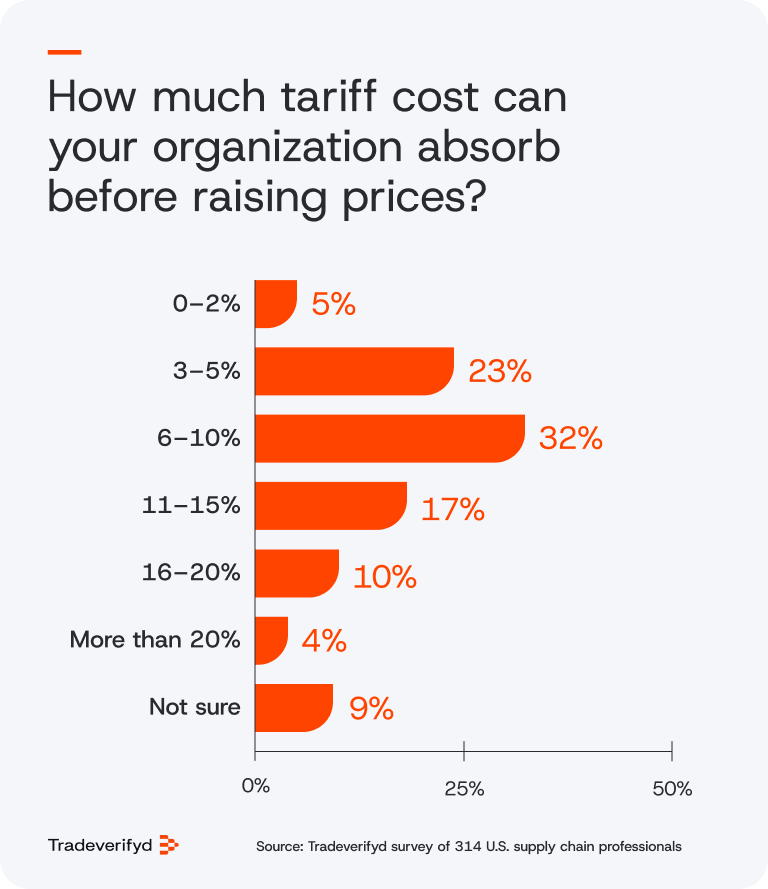
Three in 5 (60%) executives say their organizations can absorb no more than a 10% tariff-driven cost increase before raising prices, highlighting how limited margin buffers are across many supply chains.
Only 15% of executives say their organizations are able to absorb tariff-driven cost increases of 16% or more, showing that larger tariff shocks are difficult for companies to shrug off.
These results suggest that tariff-driven cost pressures often remain hidden to consumers until high prices cross a threshold at which organizations must pass costs downstream to remain profitable.
The distribution below illustrates how rapidly organizations reach that tipping point as tariff exposure increases.
Many organizations continue to absorb a large share of tariff costs internally, which helps explain why the price of many products hasn't reflected recent tariff changes.
Organizations often take this approach to maintain customer relationships and remain competitive while they assess whether tariff changes will persist.
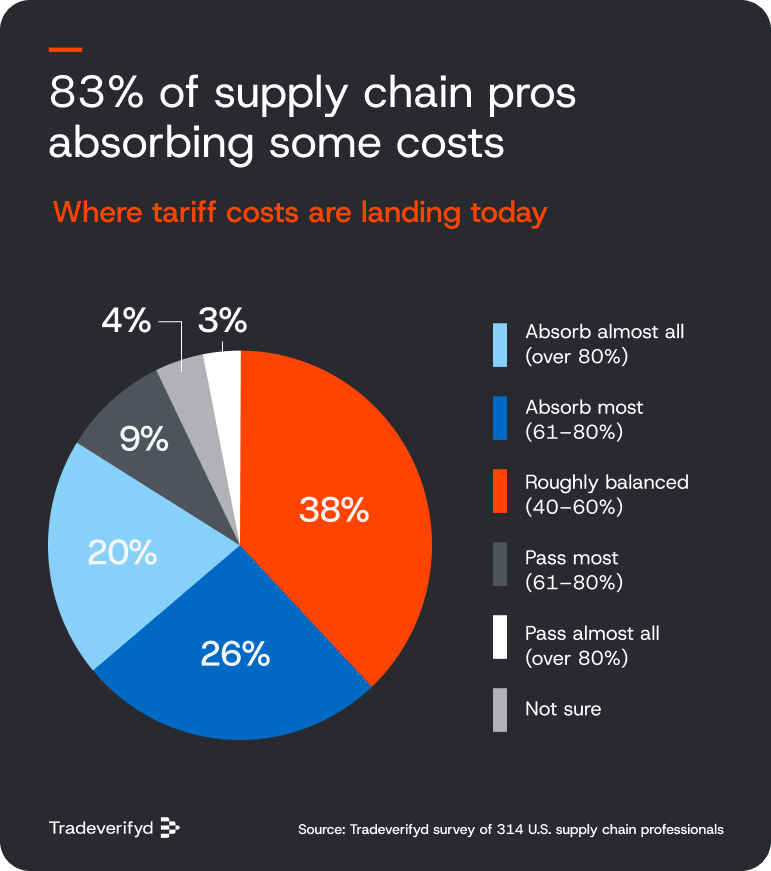
While some companies are beginning to balance tariff costs between margins and pricing decisions, full pass-through still remains relatively uncommon across supply chains today. Nearly half (46%) of executives say their organizations are absorbing most or nearly all of tariff costs. Only 12% are currently passing costs to consumers.
Here’s an illustration of how organizations are distributing tariff-driven cost pressure between margins and pricing today.
Tariffs often first appear on corporate income statements, where they drag on profitability. They later hit consumers when companies have to raise their prices to preserve profit margins.
Some companies are adjusting their sourcing strategies to avoid passing on costs, but they may need to make other changes to navigate the evolving U.S. tariff landscape as enforcement conditions change.
The majority (59%) of supply chain leaders say their organizations can absorb tariff cost increases of up to 10% before raising prices, reinforcing how quickly higher tariffs can translate into downstream pricing pressure.
This limited margin buffer means even modest tariff increases can accelerate the transition from internal absorption to customer-visible cost adjustments.
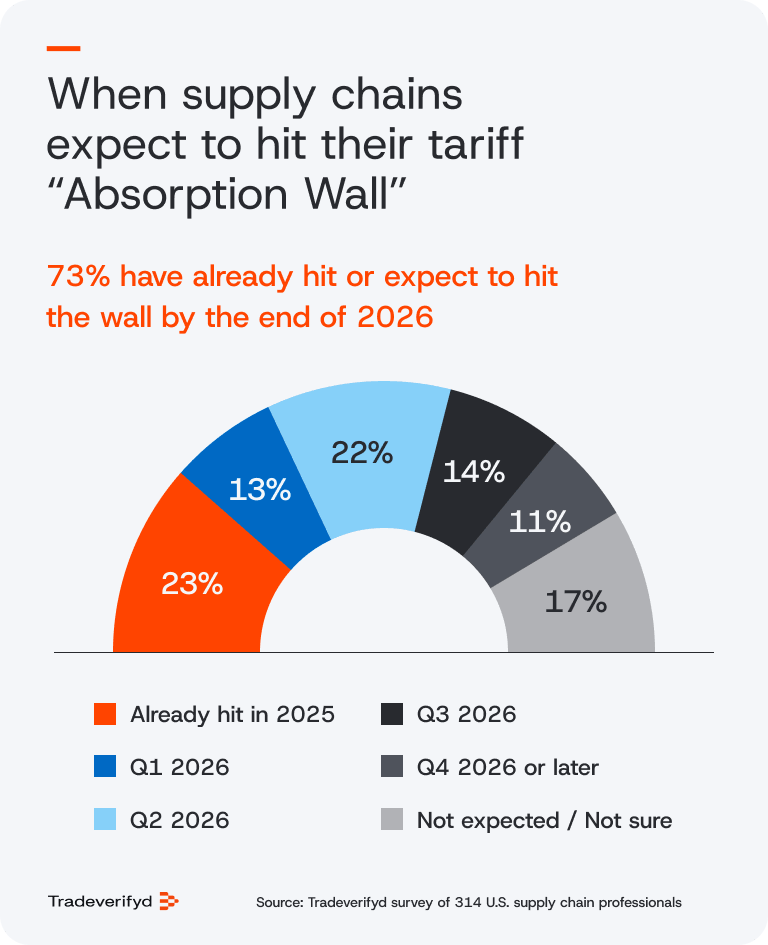
Nearly 3 in 4 (73%) executives say their organizations have already hit or expect to hit their absorption wall by the end of 2026, indicating that unless trade pressures subside, additional tariff costs will likely reach customers soon.
Here’s how quickly companies expect to reach that threshold.
"Tariff costs don't disappear; they accumulate until they can't be hidden anymore. Most supply chains were not built to sustain prolonged volatility on any front, and given the pace of regulatory change and AI advancement, the window for proactive planning is narrowing fast. Companies that lack upstream visibility will find themselves reacting to pricing pressure rather than managing it."- Karyl Fowler, Chief Growth Officer, Tradeverifyd
Tariff exposure increasingly depends on how well organizations understand the structure of their supplier networks, especially beyond Tier 1 relationships.
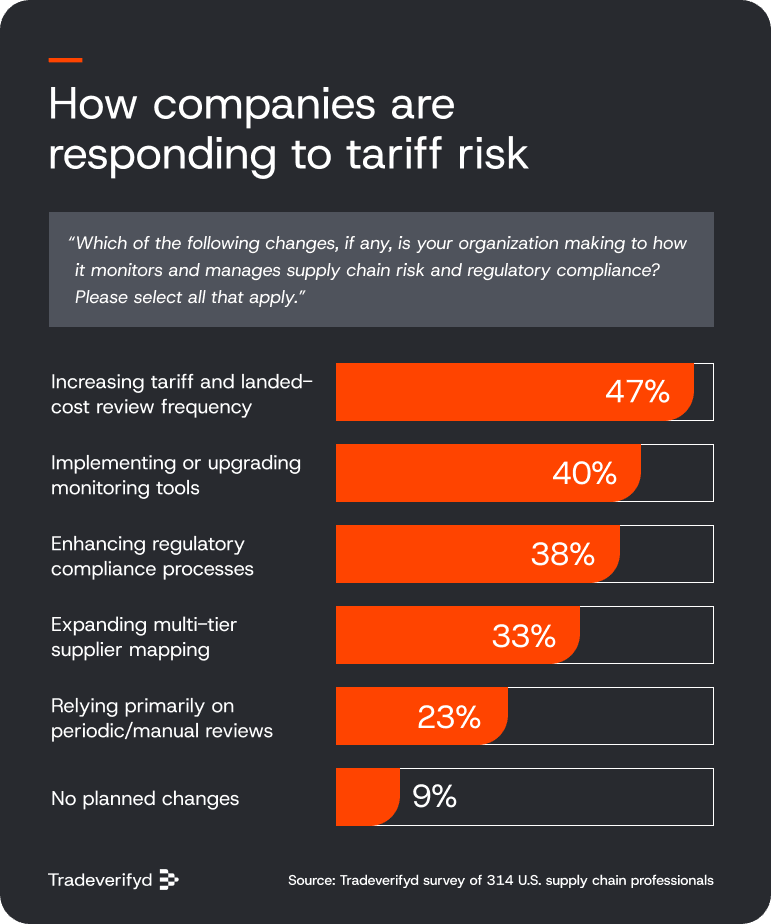
Nearly half (47%) of executives say their organizations are responding by increasing how often they do tariff and landed-cost reviews, as tariff exposure shifts upstream.
However, 53% of executives are only somewhat confident in their organization's ability to quantify tariff exposure across multi-tier supply chains. This indicates review frequency alone does not guarantee upstream visibility.
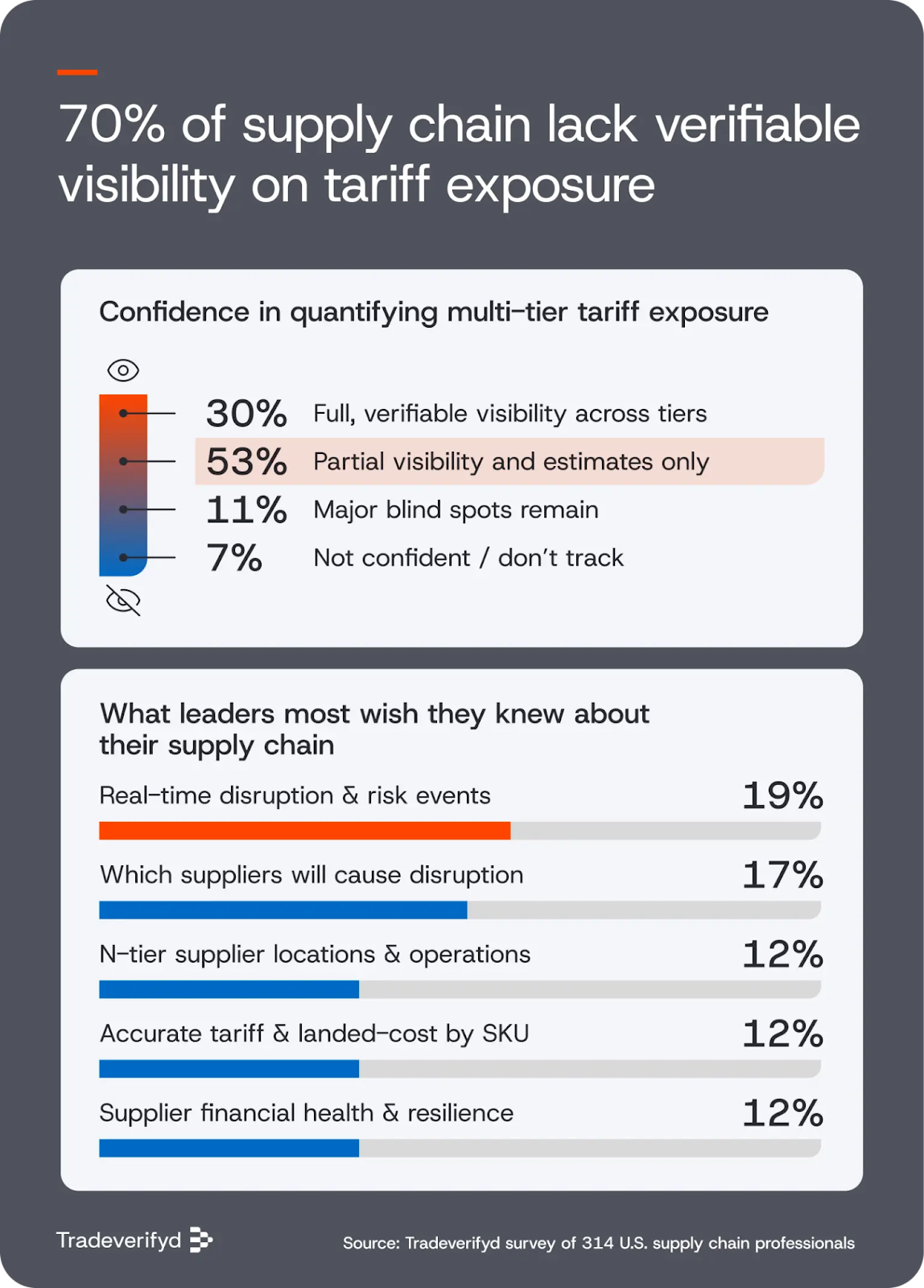
This gap highlights how tariff risk often accumulates in areas of the supply chain that are difficult to map, reinforcing the importance of identifying hidden supply chain risks and strengthening supply chain compliance requirements tied to origin verification and trade documentation.
Companies that lack visibility across multi-tier supplier networks face greater difficulty anticipating when they'll need to pass on higher costs, which, in turn, can lead to sudden price adjustments or sourcing disruptions.
Tradeverifyd's semiconductor supply chain management survey found that organizations still relying on manual tracking processes were significantly slower to identify upstream risk — a pattern that's emerging across sectors with high import reliance and geopolitical exposure, where the pace of tariff change leaves little room for reactive decision-making.
Organizations that want to respond nimbly to tariff volatility need to prioritize real-time visibility into supplier networks and landed-cost exposure to support earlier planning decisions.
Tradeverifyd provides verifiable multi-tier supply chain visibility to help organizations anticipate tariff exposure and respond earlier with greater confidence. Learn how greater upstream visibility can help your organization get ahead of tariff shifts before they reach pricing and operations.
The survey was conducted by Centiment for Tradeverifyd. The survey was fielded between February 2, 2026, and February 9, 2026. The results are based on 314 completed surveys. In order to qualify, respondents were screened to be residents of the United States, over 18 years of age, and are professionals employed in supply chain with a title of manager or higher. Data is unweighted, and the margin of error is approximately +/-3% for the overall sample with a 95% confidence level.
Resources & Insights
+
02