Blog >
Compliance & Regulations
3 min. Read
12 Best Supply Chain Monitoring Software for Enterprise Risk + Visibility
The Tradeverifyd Team
3.24.26

Knowing where your goods are, which pose a risk, and whether your sourcing meets regulatory standards is a core operational requirement. Supply chain monitoring software addresses this by tracking the end-to-end flow of goods from raw materials to finished products, surfacing disruptions and supporting real-time compliance oversight.
Not all supply chain monitoring software solves the same problem. Before comparing tools, it helps to understand which category aligns with your priorities:
- Supply Chain Risk Management (SCRM): Focuses on supplier intelligence, compliance oversight, and multi-tier risk detection for enterprises seeking supplier information and whether those relationships meet ethical and regulatory standards.
- Real-Time Transportation Visibility Platforms (RTTVPs): Track active shipments across carriers and modes for logistics teams seeking delivery timeline management, carrier performance information, and in-transit disruption monitoring.
- Supply Chain Control Towers (SCCTs): Aggregates supply chain data into a centralized dashboard for operational leaders seeking a unified view of disruptions and workflows.
Our guide collects 12 of the best supply chain planning tools, separating them into three categories based on what they offer.
Why Supply Chain Monitoring Software Is a Strategic Necessity
Supply chain monitoring software can help with proactive risk mitigation, giving organizations regulatory armor through automated tools. It encompasses features such as real-time GPS tracking, potential disruption tracking, and regulatory compliance support.
Supply chain managers are also seeing an increasingly volatile landscape:
- Aggressively enforced regulations: For example, Customs and Border Protection (CBP) has stopped 69,415 shipments worth about $3.94 billion to enforce the Uyghur Forced Labor Prevention Act (UFLPA) since early 2026.
- Changing trade policies and global risks: A 2025 PWC survey found that 91% of respondents are significantly changing their supply chain strategies in response to US trade policy, while 87% are changing due to geopolitical risks.
Massive tariff increases: Throughout 2025, U.S. import tariffs have gone from 2.6% to 13%, with some Chinese goods seeing 125 percentage point increases. Companies that operate in multiple countries must manage month-to-month changes across them.
1. Tradeverifyd
Best for: Verifiable multi-tier supplier visibility and regulatory intelligence
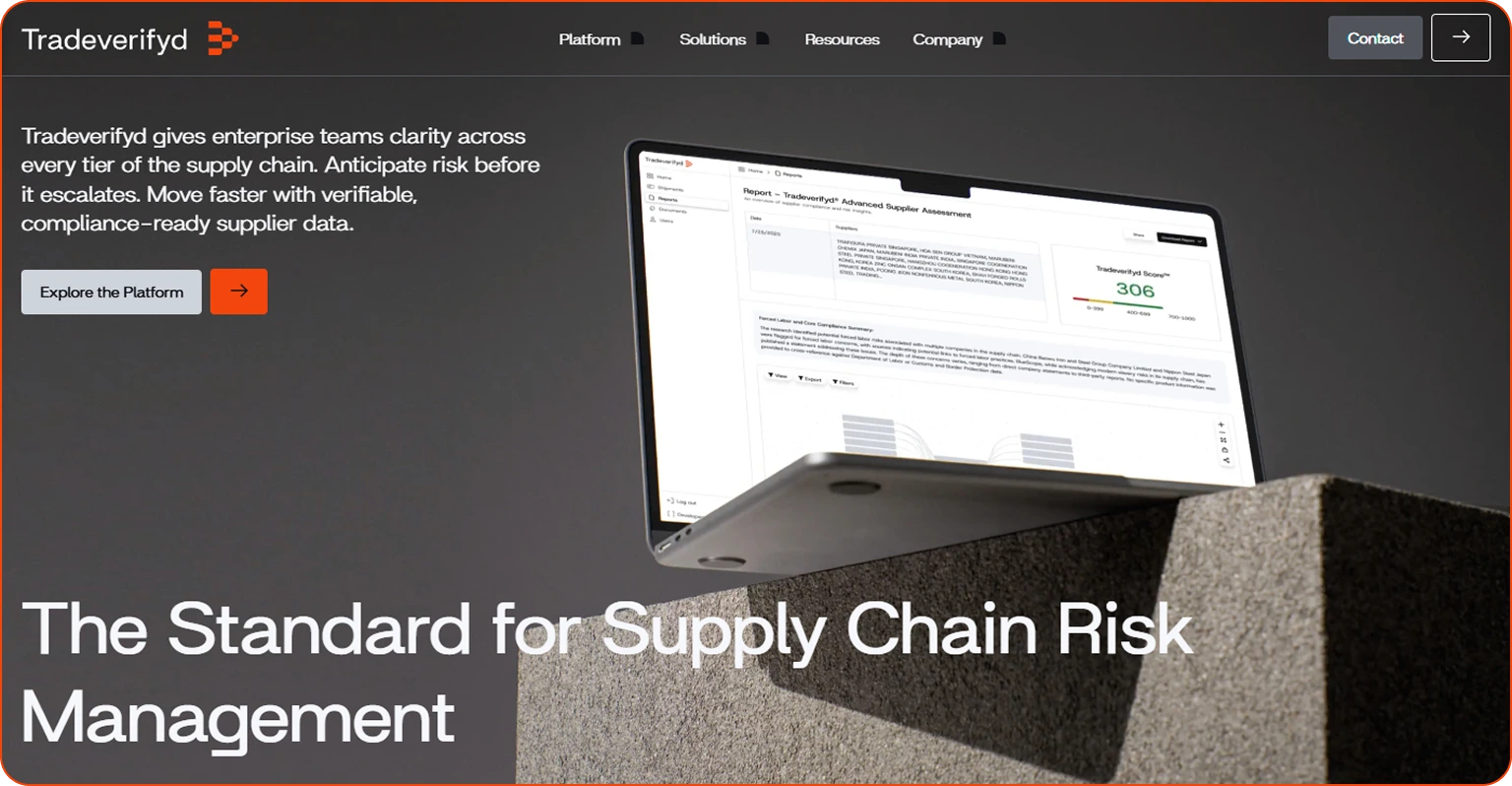
Tradeverifyd is a next-generation SCRM platform that uses agentic AI to transform compliance from a burden into a competitive edge. It relies on predictive intelligence to anticipate disruptions before they impact your business. You also get real-time regulatory tracking to keep you audit-ready with verifiable documentation across every supply tier, analyzing
Customers can identify risk levels easily with the platform’s Tradeverifyd Score™, a standardized, data-driven measure of a supplier’s ability to meet delivery and compliance requirements. These scores update in near real-time through continuous AI monitoring that highlights operational risks, regulatory issues, and concerning relationships. These scores are independent and tamper-resistant, so suppliers can’t self-report good results.
Where many logistics visibility tools stop at tracking, Tradeverifyd goes beyond this through industry-leading multi-tier mapping that reveals supplier relationships from raw inputs to finished goods. It highlights red flags found deeper in the supply chain, such as suppliers using forced labor, that violate laws like the UFLPA. It can then help you develop action plans to identify alternative suppliers and produce audit-ready documentation, making it particularly valuable for regulatory risk and supplier traceability.
It can then help you create audit-ready documentation, saving you time to focus on other strategic decisions.
Key features:
- Multi-tier supply chain mapping: Provides visibility that reaches every tier of your supply chain beyond Tier 1 suppliers.
- Tradeverifyd Score™: Sourced from verified, independent data, this score makes it easy to identify which suppliers present the most risk.
- AI-powered Predictive intelligence: Detects early signs of disruption and sends you automated notifications so you can proactively respond with solutions in place. Using agentic AI tools, it then provides mitigation strategies that help you avoid risks.
- Verifiable supplier credentials: Provides customs-ready supplier documentation to keep goods moving through customs.
Pricing: To learn more about our solutions and for pricing details, request a demo here.
2. Resilinc
Best for: Global event tracking
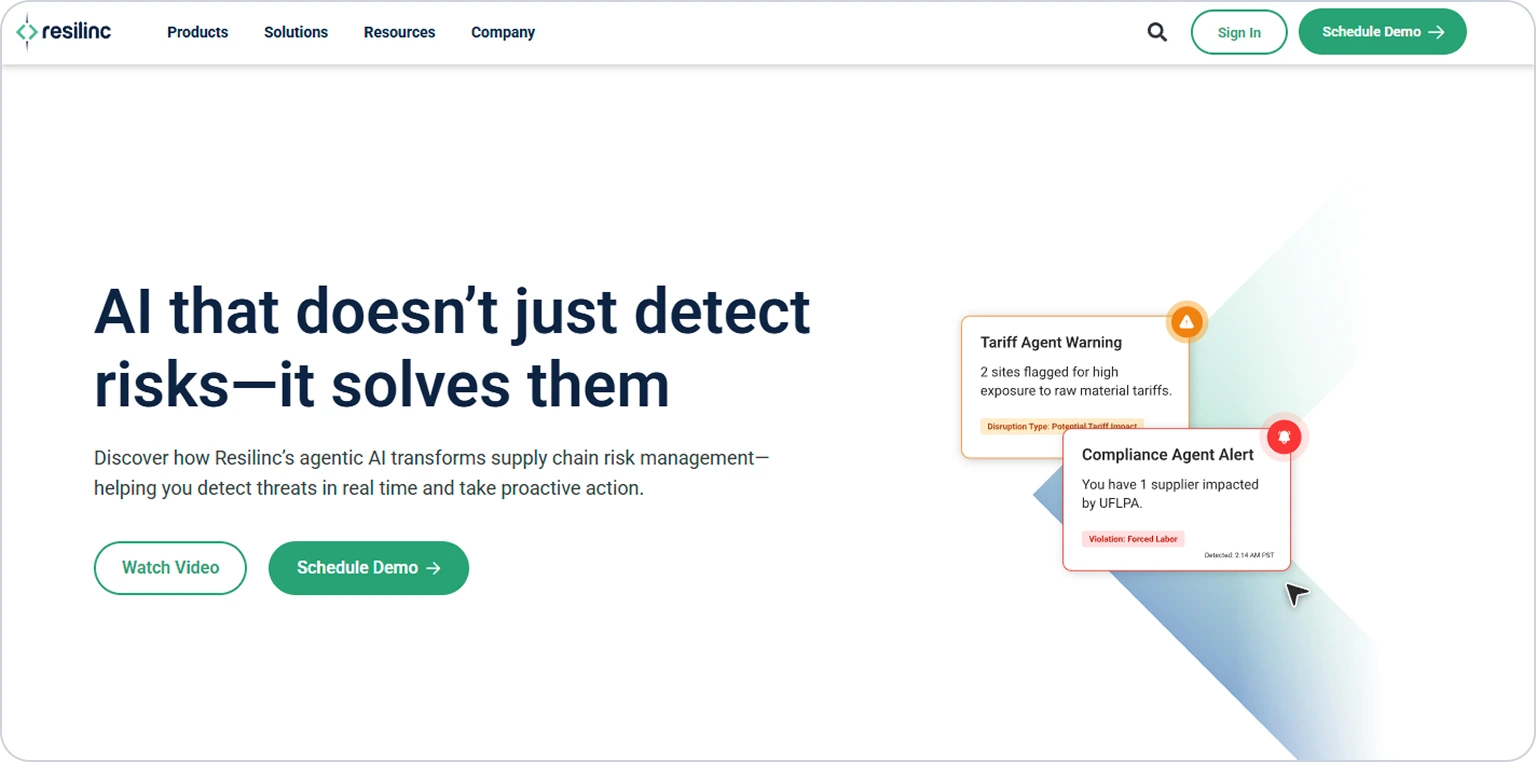
Resilinc is an SCRM platform built for large-scale enterprise operations that require automated event tracking. It relies on AI to proactively track global events, such as factory fires or inventory shortages, making the tool ideal for hardware-dependent industries that rely on parts manufacturers. Through AI features, Resilinc maps supply chains and suggests mitigation strategies based on global findings.
Resilinc offers many tools, but at least one review says the newly introduced features haven't benefited them and aren’t evolving fast enough. Another review has noted issues with integrating financial ratings, supplier information, and materials information.
Key features:
- Agentic AI Suite: Assists with supply chain operations by providing direction through mitigation strategies or alternative supplier options.
- EventWatch: A 24/7 global risk monitoring system that scans news outlets, social media pages, and more across over 100 languages and 200 countries.
- WarRooms and scenario planning: Predictive tools that use AI to run what-if scenarios that model potential supply chain impacts.
- Supply chain mapping: Provides visibility into which hardware parts are made at different supplier locations.
Pricing: For the most up-to-date pricing structures, visit the Resilinc website.
3. Sphera
Best for: Environmental and Social Governance (ESG)
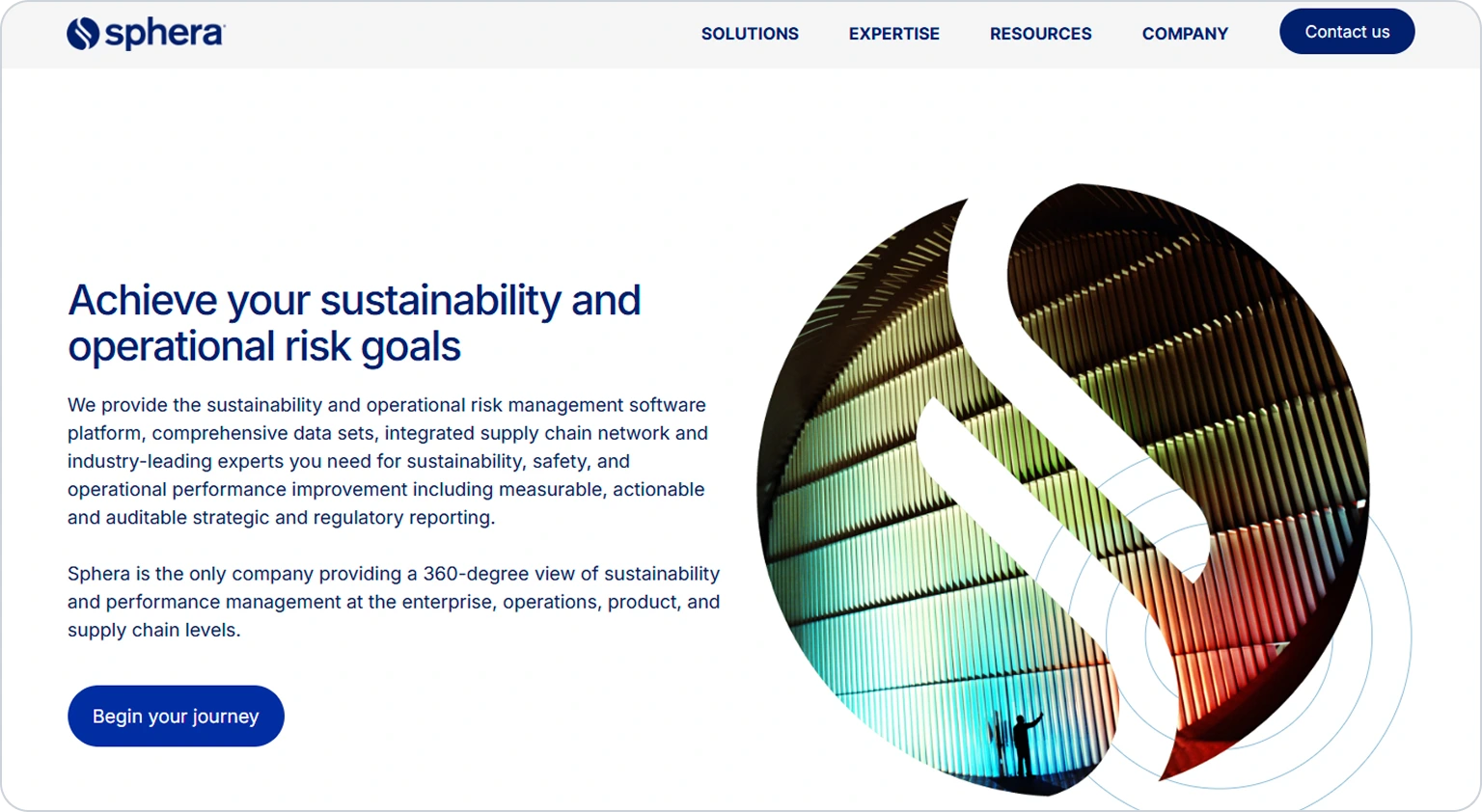
Sphera is an ESG platform that serves environmentally sensitive industries, including chemicals, metals, and gas. The platform provides sustainability-enabled tools to monitor your supply chain, including life-cycle assessments (LCAs) and product stewardship tools to identify environmental and compliance issues.
Much like Resilinc, at least one reviewer noted that implementation was complex, especially for more complex operations that require multiple solutions. Another review found that it’s less valuable for compliance and cybersecurity needs.
Key features:
- Supplier 360 Intelligence: Provides an AI-generated snapshot of supplier risks, including finances, operations, structure, and reputation.
- N-Tier Mapping: Identifies sub-tier supplier relationships that could violate compliance rules.
- Action Planner: Automates plan creation in response to risks identified through automated notifications.
- Action Planner: Links AI-tracked risk signals to risk mitigation workflows to automatically build action plans to respond to crises.
Pricing: For the most up-to-date pricing structures, visit the Sphera website.
4. Everstream Analytics
Best for: Predictive logistics intelligence
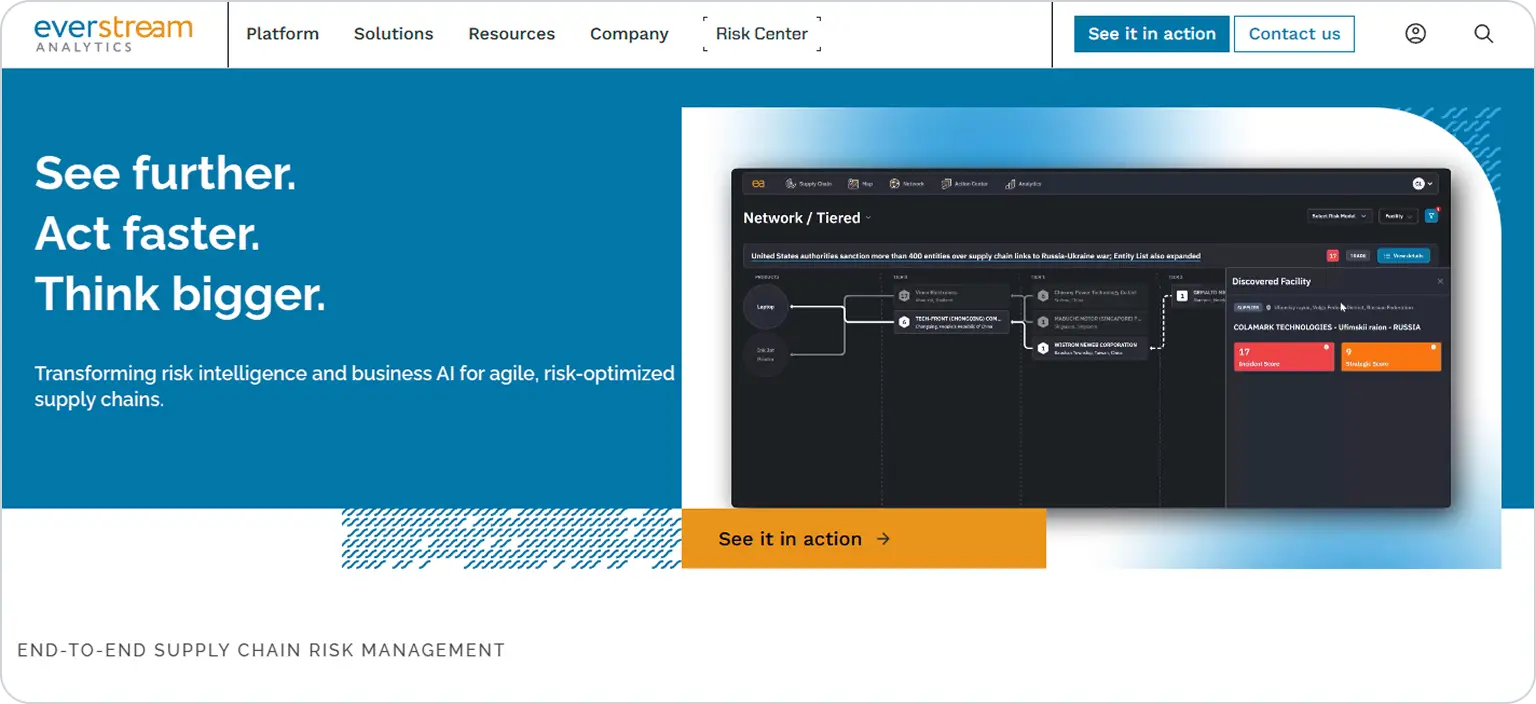
Everstream Analytics is an SCRM platform that provides predictive logistics intelligence tools to proactively identify risks. Customers who use the platform can create a digital twin of their supply chain to help identify external threats such as inclement weather, geopolitical unrest, and labor strikes. Also, like RTTVPs, Everstream provides real-time supply chain visibility through GPS tracking data.
On the negative side, one review found that Everstream requires more human translation and wished it offered more auto-generated action planning. Another reviewer had issues with software bugs and the complex setup of automation tools.
Key features:
- Network mapping: Identifies supply chain risks by mapping sub-tier supplier relationships.
- Global monitoring and alerts: Real-time monitoring and alerts of risks across your entire supply chain.
- Supplier scorecards: Easily assess supplier vulnerability with historical data and predictive monitoring.
- What-if planning: A tool that lets users model what-if scenarios based on different risk signals to adapt their current plans.
Pricing: For the most up-to-date pricing structures, visit the Everstream Analytics website.
5. Project44
Best for: Large-scale logistics tracking
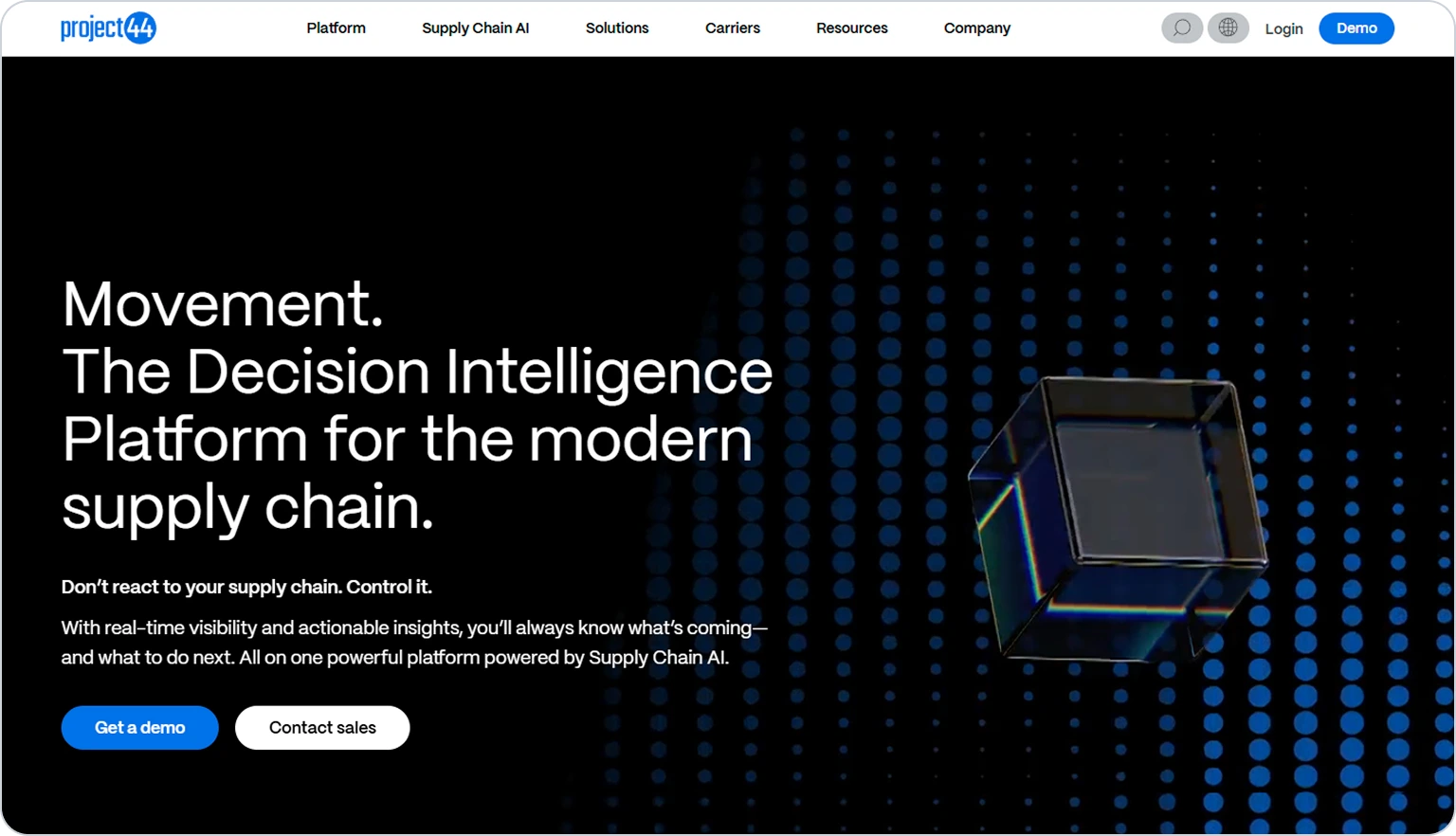
Project44 is an RTTVP platform with a massive global network of carriers, forwarders, and telematics devices to track freight in motion. It manages over 1.5 billion shipments and 7.3 trillion datapoints, tracking everything from air shipments to individual parcels. Customers can also get help with freight procurement, selecting new carriers based on past performance and contract hits.
Looking at critics, customers have found issues with customer service, finding lengthy support ticket delays and overly technical explanations that may not help end users. Others have found the implementation process to be slow.
Key features:
- Movement: Project44’s platform and dashboard that offers shared visibility between you and customers for ETAs, data quality diagnostics, and real-time analysis based on historical data.
- AI Disruption Navigator: A predictive tool that highlights supply chain disruptions (natural disasters, geopolitical events, etc.) and points out how this may impact shipments.
- MO: An AI supply chain assistant that relies on your data and changing events to answer complex questions about your supply chain.
- Scenario planning: Predicts supply chain volatility with what-if scenarios to test how changes could impact revenue.
Pricing: For the most up-to-date pricing structures, visit the Project44 website.
6. FourKites
Best for: AI-enabled logistics management
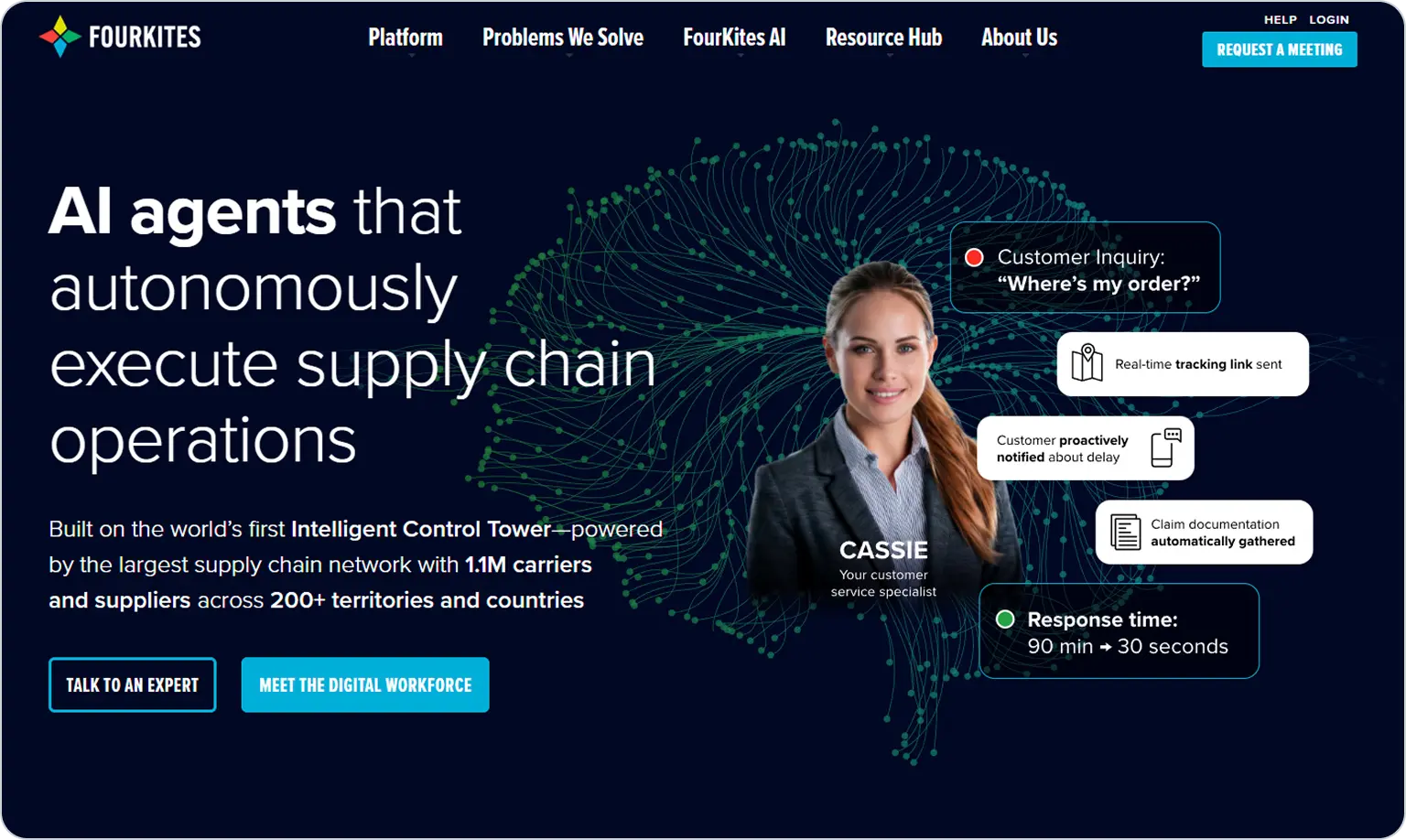
FourKites is an RTTVP platform that works with 18 of the top 20 food and beverage (F&B) brands. The company provides logistics analysis tools that support predictive ETAs and yard management to overcome shipment delays. Loft, the FourKites AI agent platform, features “digital workers” that work across procurement, customer service, and sustainability reporting systems.
At least one reviewer found that its GPS tracking tools provide false data, indicating a load is delivered when it leaves the geofence. Another reviewer found issues with customer service, needing to switch between multiple project managers and service professionals.
Key features:
- Loft: Autonomous resolution of track-and-trace tasks to help resolve simple routines (like assigning barcode IDs) that may slow down your operations.
- Digital twins: Unify separate systems to create a digital twin of your supply chain, making tracking from shipment to arrival easier.
- Control Tower: Assesses the potential impact of disruption events across their network to help teams adjust inventory levels and reroute shipments.
- Predictive intelligence: FourKites uses a massive network of over 1,600 companies to predict supply chain disruptions through pattern recognition.
Pricing: For the most up-to-date pricing structures, visit the FourKites website.
7. Infor Nexus
Best for: Global supply chain management
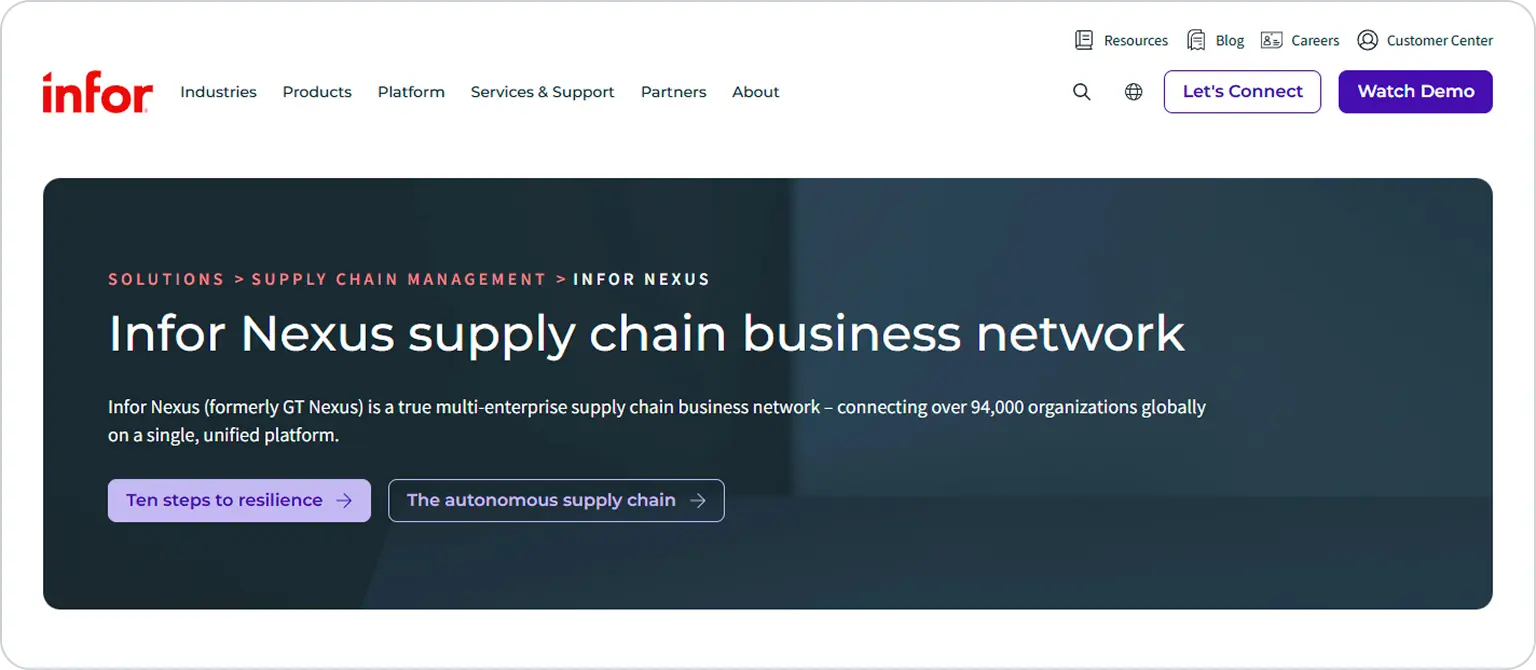
Infor Nexus is a cloud-based SCCT designed for large, global enterprises that need to manage complex networks of factories, third-party suppliers, and carriers. The larger platform behind it, Infor, includes financial management, ESG support, human capital management (HCM), and enterprise resource planning (ERP).
With these complex tools, at least one reviewer found that customizing the platform was tedious and time-consuming. In addition, another reviewer found that it doesn’t support multi-leg transportation visibility, creating potential “blackout” periods for goods in transit.
Key features:
- Procure-to-pay (P2P) automation: Cross-checks freight invoices against your carrier contracts to automatically flag billing errors.
- NexTrace: Provides N-Tier mapping to trace the chain of custody for raw materials down to Tier-3 suppliers.
- Nexus control center: Continuous supply chain monitoring to flag bottlenecks of transit delays with a shared team dashboard to plan alternative routes.
- Supplier management: A dedicated portal where you, your team, and your suppliers can share production updates and manage digital purchase orders without digging through old emails.
Pricing: For the most up-to-date pricing structures, visit the Infor Nexus website.
8. SAP SCM
Best for: Existing SAP enterprises
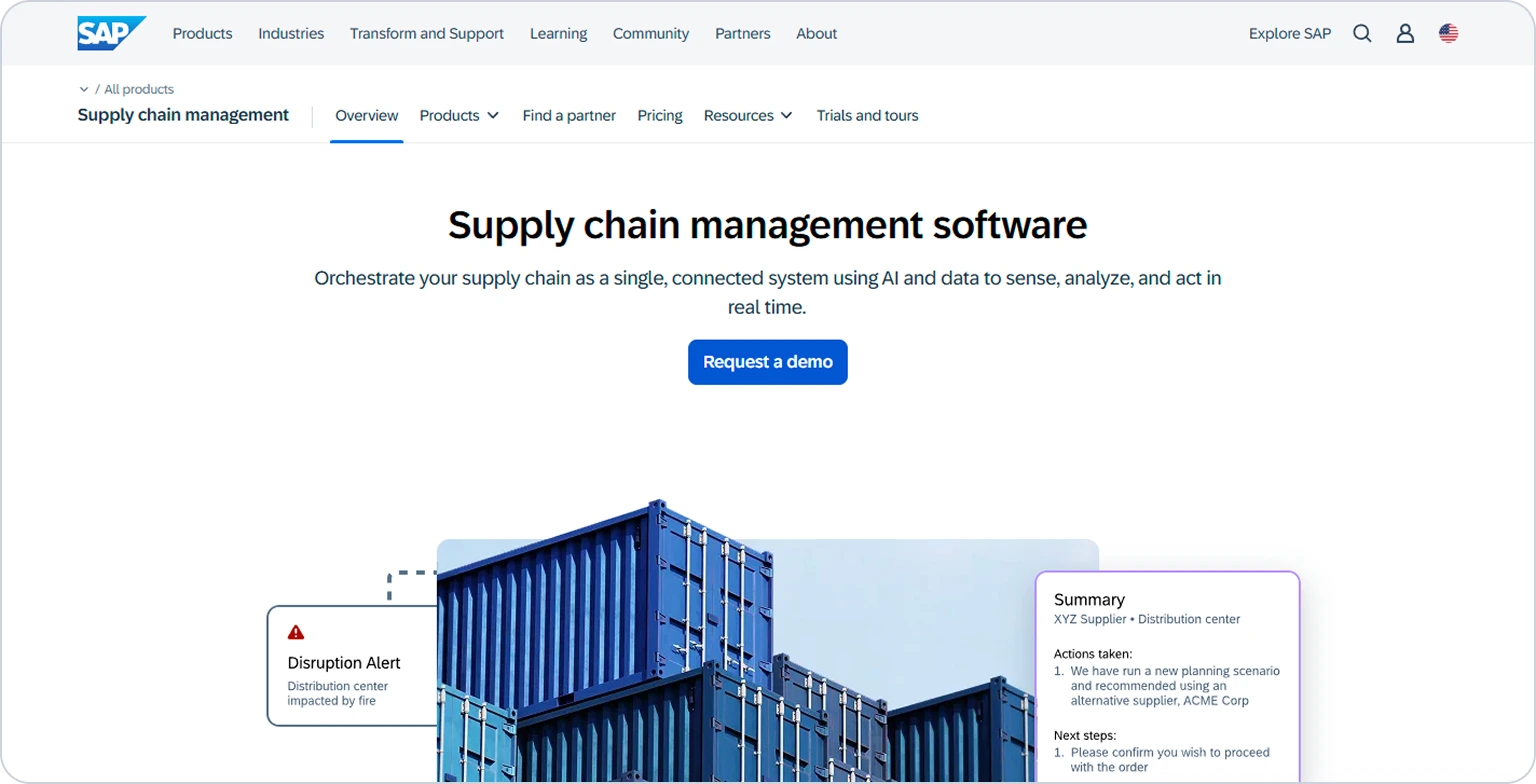
Systems Applications and Products in Data Processing (SAP) is a market leader in cloud-based enterprise resource planning (ERP) software. SAP SCM is its supply chain management system, and it's an SCCT tool that helps with procurement and product lifecycle management. Current SAP customers will benefit from the platform’s simple integrations.
SAP may not be ideal if you aren’t willing to go all in. One customer found that businesses can become dependent on the company, making it difficult for them to adopt updated tech. Other customers have found that the platform needs further development, sometimes struggling to integrate SAP with its own products.
Key features:
- Automated statistical forecasting: Reviews past sales and current market trends to predict customer purchases to help you avoid ordering too much.
- Supply chain mapping: Captures supply chain visibility from raw materials to finished goods to help improve ESG sustainability metrics.
- Procedure Playbooks: A cloud-based app that helps document and standardize best practices between different departments.
- Logistics tracking: Provides real-time visibility of inbound and outbound shipments to help spot bottlenecks.
Pricing: For the most up-to-date pricing structures, visit the SAP SCM website.
9. Oracle SCM
Best for: Product and equipment lifecycle management
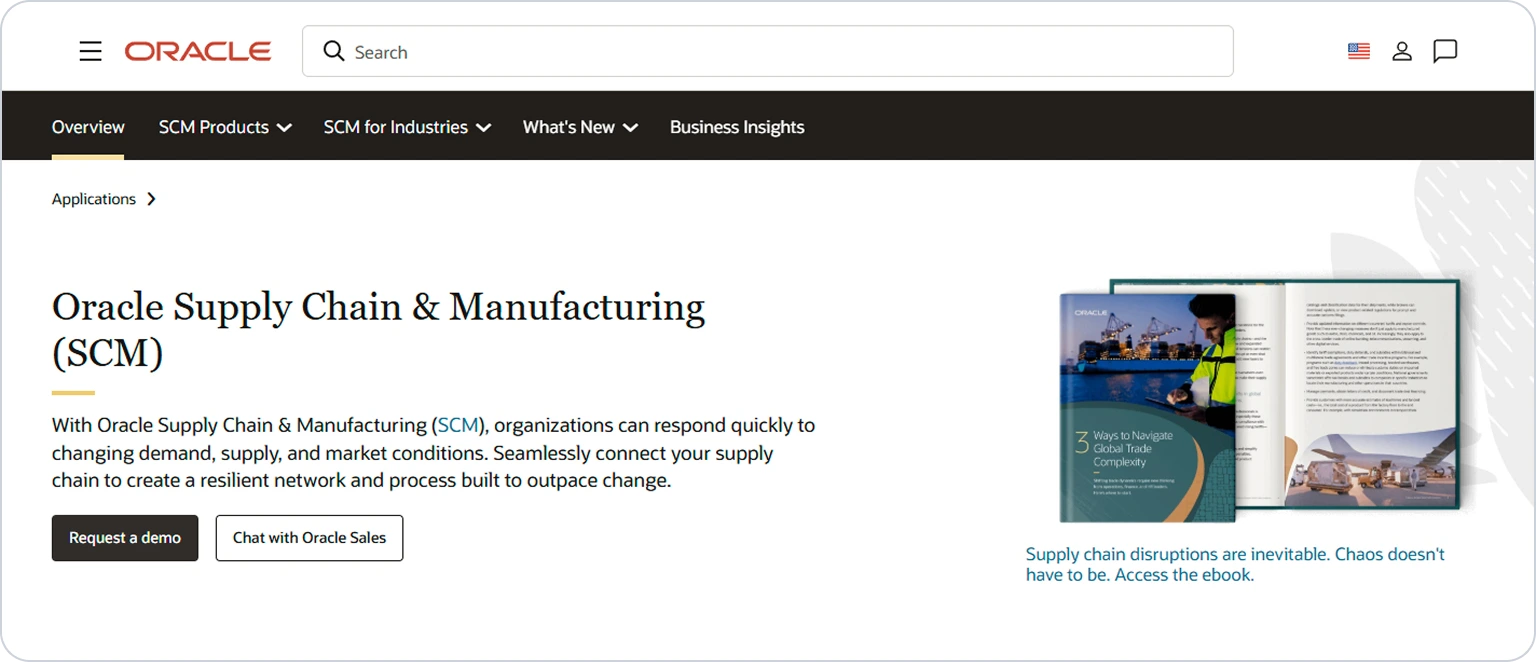
Oracle SCM is an all-in-one ERP platform that doubles as an SCCT for supply chain management. Like SAP, it offers several apps for distribution, manufacturing, inventory, and fleet management. It’s helpful for manufacturing companies that want to track production line efficiency to spot quality issues early. Its platform, Oracle Fusion Cloud SCM, tracks the supply chain by estimating demand and forecasting sales numbers.
One reviewer found numerous issues with integrations, an inability to break down demand forecasting by warehouse, or a lack of clear visibility for decisions. Others have found the platform challenging to work with when using large datasets. Like SAP, it may not be best if you want supplier risk management software that integrates outside of Oracle tools.
Key features:
- Planning suite: Runs what-if scenarios to model how risks can impact production schedules and revenue.
- Inventory management: A global view of how much product you have in warehouses versus moving in transit to avoid tying up your budget in storage costs.
- Logistics management: A central hub for booking, routing, and tracking freight to help teams handle international customs compliance.
- Procurement automation: Provides buyers with a portal to evaluate vendor contracts and review purchase orders for payment via Oracle.
Pricing: For the most up-to-date pricing structures, visit the Oracle SCM website.
10. Blue Yonder

Best for: Retail planning and management
Blue Yonder is an SCCT platform that works with over 3,000 customers in the apparel, automotive, and consumer goods industries. They emphasize AI automation, providing tools to help manage supply chains, logistics, inventory levels, and ordering. The company’s Supply Chain Command Center highlights bottlenecks in the flow of goods by tracking factories, distribution centers, or brick-and-mortar storefronts.
Reviewers have found issues with the use of external data in forecast models and the lengthy customer resolution process. Others have found the training materials somewhat weak and would like them to be more specific for different roles.
Key features:
- Network risk management: A testing platform for different business decisions to estimate how changes may impact your budget.
- AI recommendation engine: Watches for supply chain disruptions and automatically suggests shipment rerouting or adjusting manufacturing schedules.
- Chain of custody traceability: Tracks the origin of the different parts that make up your product to meet customs compliance requirements.
- Luminate Control Tower: Scans global news and geopolitical shifts to provide real-time data for identifying risk signals and predicting delays.
Pricing: For the most up-to-date pricing structures, visit the Blue Yonder website.
11. Kinaxis
Best for: What-if scenario planning
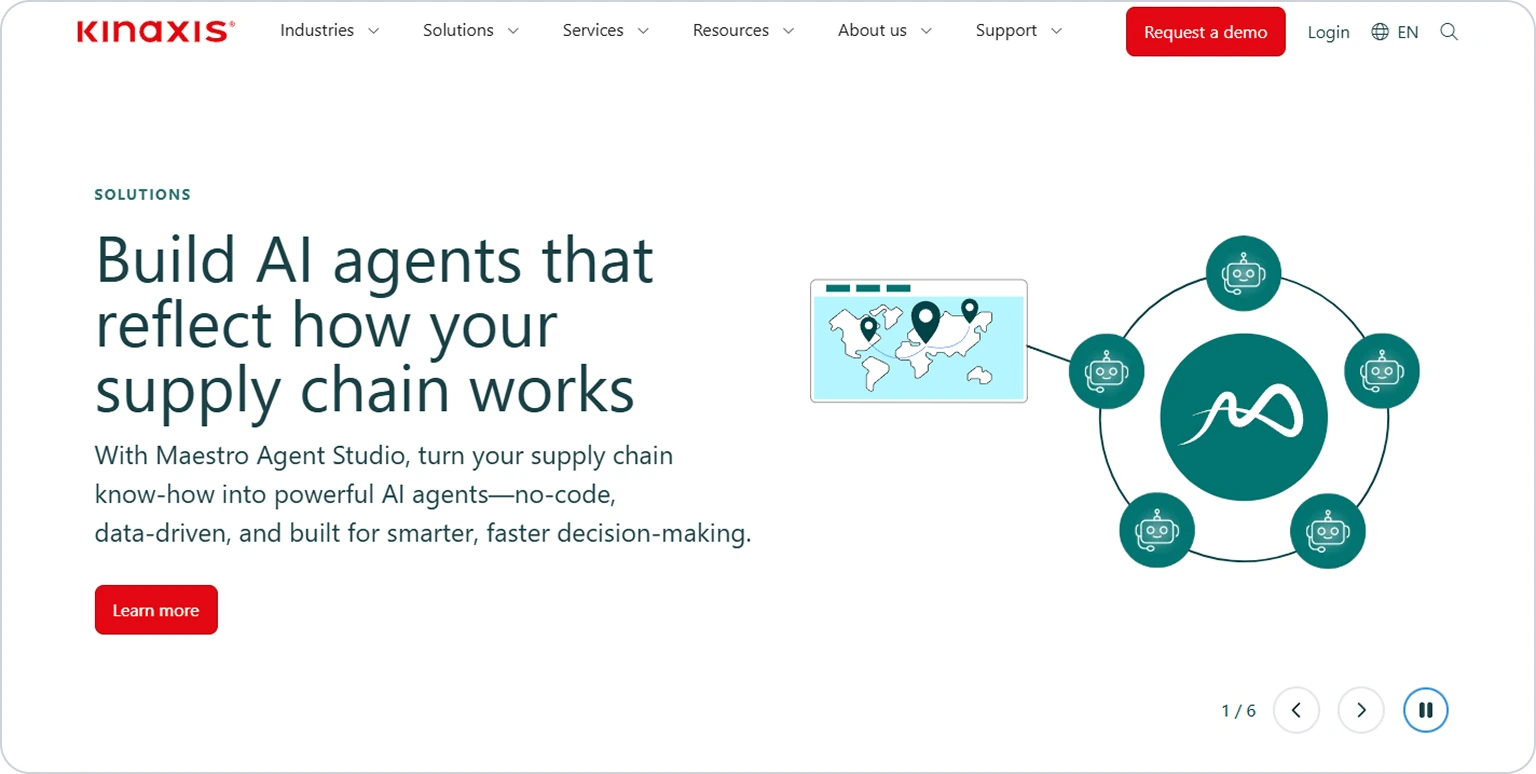
Kinaxis is a cloud-based SCCT tool that leverages AI agents to review supply chain data, analyze business health, and support agile decision-making. The company provides supply chain orchestration tools through its Maestro (formerly RapidResponse®) platform, supporting concurrent data sources that help break down information silos.
At least one reviewer found issues with the accuracy of demand forecasting, a critical issue in supply chain monitoring. Others have found performance issues that can heavily impact their ability to use the tool.
Key features:
- Supply chain data fabric: Pulls data from old Excel spreadsheets, supplier emails, and newer data sets to understand and map your operational process.
- Intelligence engine: Continuous, AI-driven background reviews to flag inventory shortages or demand spikes before they occur.
- Maestro S&OP: A sales and operations planning (S&OP) tool that lets users create what-if scenarios to determine how risks could impact their budget and operations.
- Concurrency tools: Connects data from global operations to help you understand how delivery delays or factory schedule changes may affect your organization’s plans.
Pricing: For the most up-to-date pricing structures, visit the Kinaxis website.
12. Continuity2
Best for: Crisis plan creation and deployment
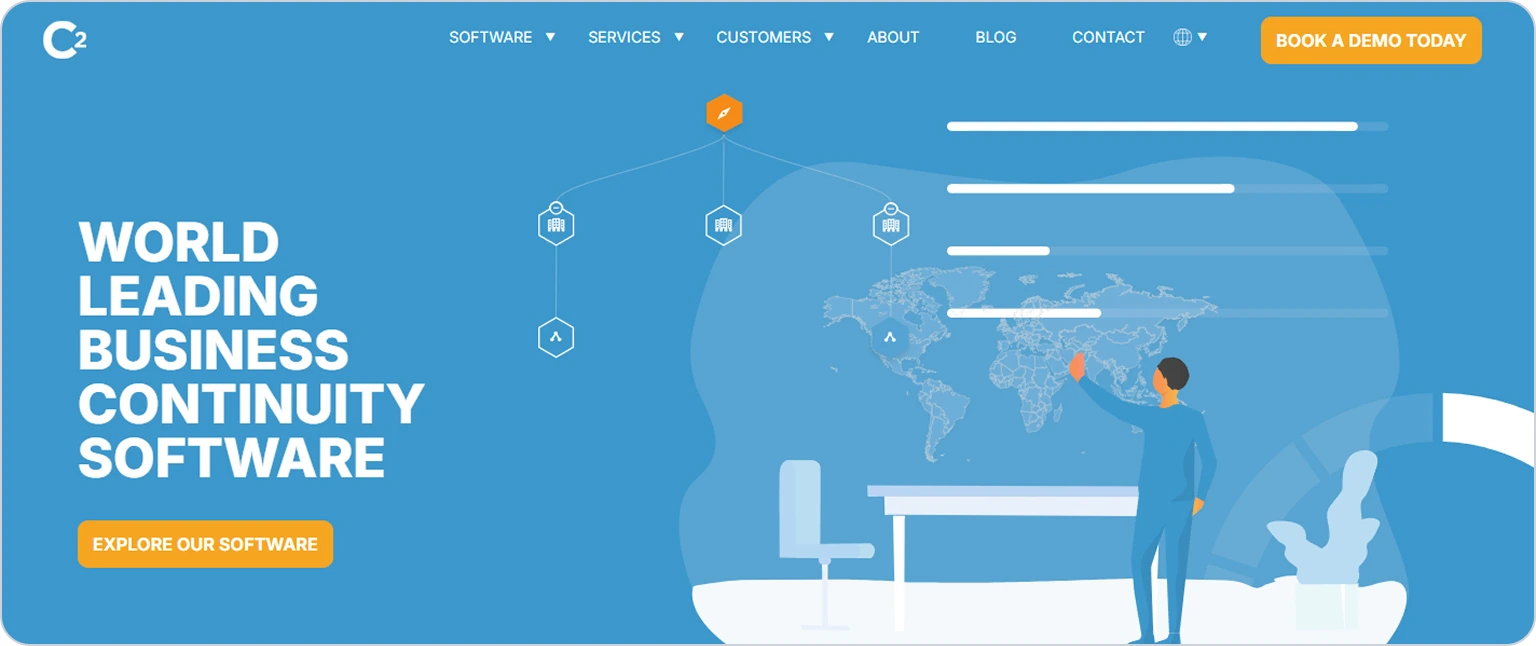
Continuity2, or C2, is an SCRM platform that’s better described as a business continuity risk management (BCRM) platform providing crisis management tools. The “BCRM” aspect stems from its internal management tools that help create response plans and broadcast alerts during emergencies, such as when a supplier refuses to deliver goods.
Reviewers have found issues with data errors when multiple users can edit fields simultaneously. In addition, changes to your organization in the tool can remove departments or activities you have already set up, requiring customers to jump back in to make corrections.
Key features:
- Business Impact Analysis (BIA): Maps out business functions to predict how much money or operational capacity would be lost if risks become reality.
- Digital plan library: Stores crisis response plans and enables team members to build, update, and maintain these step-by-step documents to keep others informed.
- Risk management tools: A module that alerts you to potential risks such as port strikes or geopolitical issues with a simple scoring system.
- Operational resilience tracking: Locates hidden dependencies between internal processes or external vendors to help define how much disruption your business can tolerate before failing.
Pricing: For the most up-to-date pricing structures, visit the Continuity2 website.
Turn Compliance Into a Competitive Edge with Tradeverifyd
Supply chain monitoring software covers risks ranging from GPS tracking to supplier risk assessment. Global organizations must identify their greatest needs. One of the most complex of these is identifying compliance risks you can’t see, and many platforms don’t have a solution for that.
That’s where Tradeverifyd is built differently.
Unlike logistics visibility platforms, Tradeverifyd is designed for organizations that need verifiable supplier intelligence and compliance readiness across every tier of their supply chain. It automates regulatory compliance by identifying documentation gaps before audits, notifying you of legal changes likely to affect your sourcing, and flagging multi-tier supplier risks tied to those changes, giving your team the evidence to act with confidence.
Book a demo today to learn how you can use Tradeverifyd to turn regulatory hurdles into a competitive edge.