Tradeverifyd Names Amanda Greene Chief Operating Officer to Lead Next Phase of Scale
Former Airbnb and Oyster HR operations leader brings two decades of experience scaling AI-enabled, high-growth companies


Blog >
Compliance & Regulations
The Tradeverifyd Team

The days of checkbox-style UFLPA compliance are over. U.S. Customs and Border Protection (CBP) now operates at the transaction level, examining individual shipments and demanding granular documentation that most importers aren’t prepared to produce. In 2026, an expanded entity list and expanding global regulations have raised the bar even further.
Manual workflows and periodic audits fail to keep pace with this level of scrutiny. Relying on spreadsheets creates a visibility lag that carries heavy operational risks in today’s enforcement climate. Staying ahead of CBP now requires automated, data-driven transparency across every tier of your supply chain—and that’s precisely what Tradeverifyd is built to provide. Below, we break down the critical strategies for surfacing hidden sub-tier risks and ensuring your shipments clear customs without delay.
The Uyghur Forced Labor Prevention Act took effect in June 2022 to target goods linked to systemic forced labor practices in China’s Xinjiang region. Under this law, any item entering the United States is subject to scrutiny if any part of its mining or manufacturing process can be traced back to the region, regardless of how many steps removed the Xinjiang connection may be.
UFLPA operates under a rebuttable presumption standard, which distinguishes it from most traditional compliance frameworks. CBP presumes any goods with a Xinjiang nexus were produced using forced labor, and the burden falls entirely on the importer to prove otherwise with clear and convincing evidence. Meeting that standard requires a level of supply chain visibility that most enterprises have yet to build.
CBP’s enforcement focus is guided by the government’s broader UFLPA strategy, which has expanded significantly beyond the industries that first drew initial scrutiny. While polysilicon and solar components remain high priorities, 2026 targeting now includes:
As the UFLPA Entity List grows, CBP is increasingly pursuing Xinjiang links buried several layers deep in automotive and medical device supply chains.

Automotive and medical device manufacturers face particularly acute exposure. These industries rely on tightly sequenced component flows where a single detention can ripple across an entire production schedule. Clearing customs under UFLPA enforcement requires understanding four key compliance realities:
Adopting a proactive approach to these standards is essential, as the impact of one compliance failure quickly triggers a cascade of broader business risks.
The consequences of falling short of UFLPA standards compound quickly, and they rarely stay contained to a single shipment or business unit. These procurement risks create immediate operational disruptions, while the downstream financial and reputational damage can persist long after the initial incident.
A UFLPA detention impacts four key areas of the business:
Most of these consequences share a common thread: they stem from a lack of supplier visibility. For procurement and legal teams, that means the question isn’t whether to invest in deeper supply chain intelligence—it’s how quickly that infrastructure can be built before the next enforcement action hits.
Understanding the risks is the first step. Building the infrastructure to manage them is where most enterprises struggle. The following five practices form the foundation of a defensible, audit-ready UFLPA compliance program.
Most enterprises have reasonable visibility into their Tier 1 suppliers, but Tier 2 and Tier 3 relationships are rarely mapped with any precision. Under UFLPA, this lack of supply chain transparency is a legal liability. CBP doesn’t limit its scrutiny to direct suppliers, and the presumption of forced labor applies regardless of how many steps removed from Xinjiang a product’s origin is.
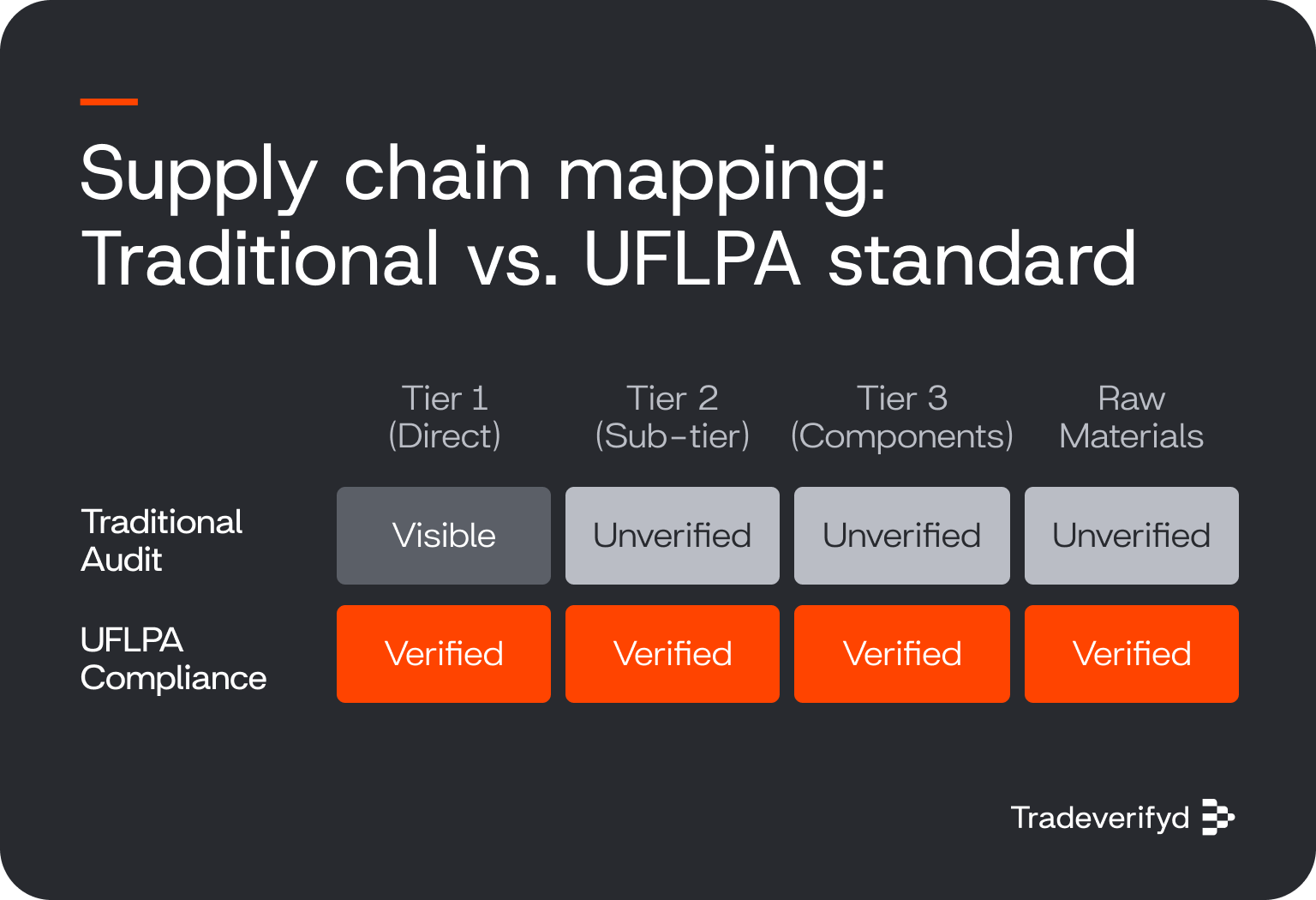
Tradeverifyd’s multi-tier mapping gives procurement and legal teams visibility that traditional supply chain visibility tools simply don’t reach, including hidden geographic concentrations, undisclosed subcontractors, and raw material origins.
For enterprises operating in high-risk commodity categories, that depth of visibility is what separates a clean import from a CBP detention.
Relying on spreadsheets or manual review cycles to track the UFLPA Entity List is a compliance risk in itself. DHS updates the list regularly, adding new entities, subsidiaries, and aliases, and any lag between an update and your internal review is a window of undetected exposure.
Real-time automated screening removes that lag by continuously monitoring the entity list and alerting compliance teams the moment a supplier in their network appears or is updated. Tradeverifyd cross-references your supply chain data against the entity list to surface matches across both direct and sub-tier suppliers. This real-time visibility keeps your team ahead of enforcement activity rather than reacting to it.
CBP expects an unbroken trail of evidence that reaches all the way back to the origin of the raw material. A signed affidavit from a Tier 1 supplier won’t, on its own, satisfy the UFLPA's rebuttable presumption. To pass an applicability review, your documentation must be granular, translated, and highly organized.
Key records for your evidence package include:
Note: All records must be translated into English and organized in accordance with CBP's submission standards. Incomplete or untranslated documentation is among the most common reasons evidence packages are rejected.
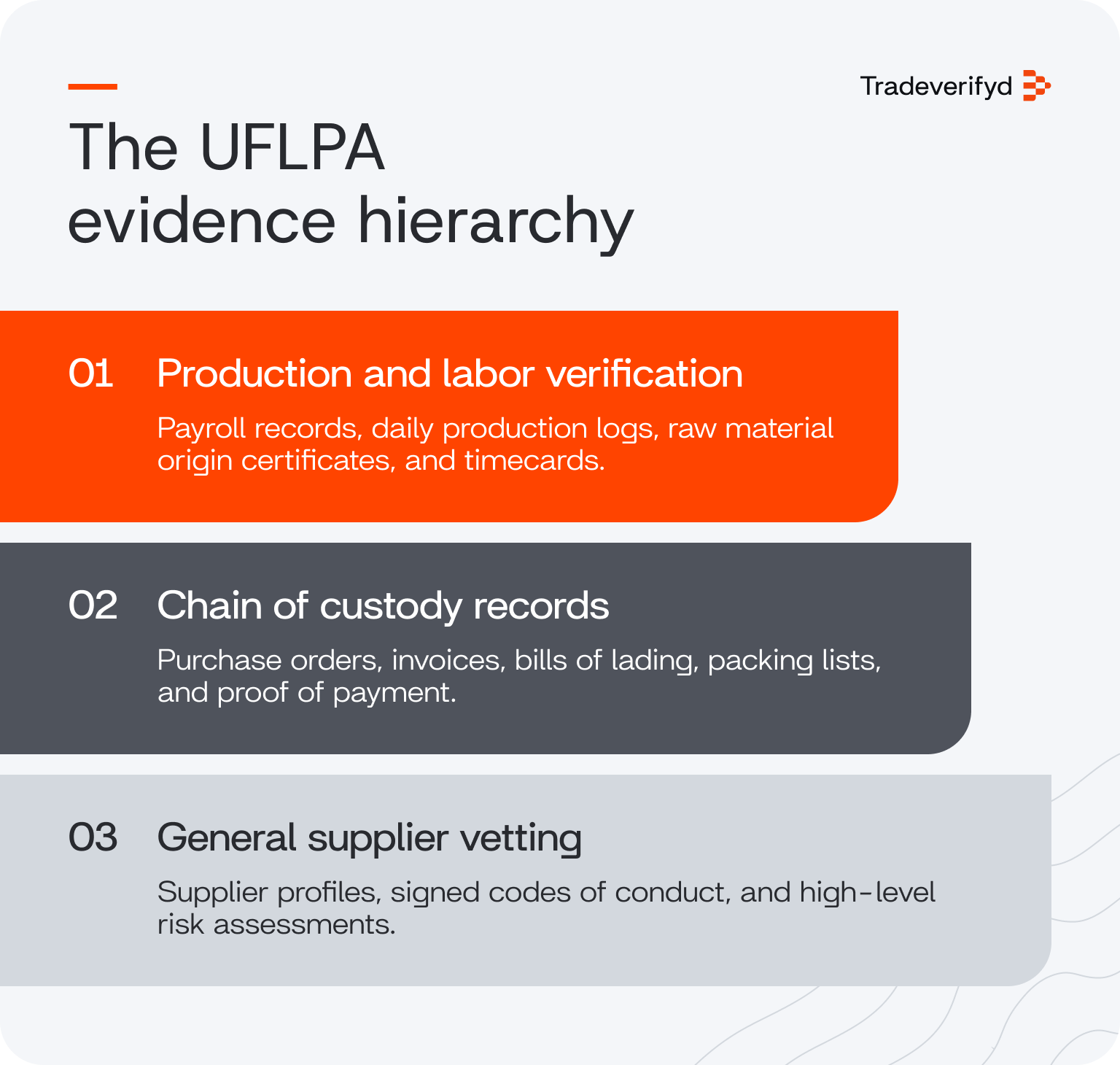
Most teams struggle to pull these records together within the strict 30-day response window allowed after a detention. Scrambling to collect and translate documentation after a shipment has already been flagged usually results in a permanent exclusion.
Tradeverifyd centralizes chain-of-custody data and automatically maps it to specific shipments. The platform uses Digital Product Passports and verifiable credentials to keep your evidence organized and ready for a CBP audit well before your goods reach the port.
Forced labor risk often clusters in specific regions or flows through transshipment hubs. While the law focuses on Xinjiang, enforcement data shows a heavy focus on shipments from Malaysia, Vietnam, and Thailand. These countries often act as intermediaries for raw materials or subcomponents originating in high-risk zones.
A proactive risk assessment uses real-time logistics and geopolitical data to surface anomalies, such as factories exporting lithium-ion batteries without a documented local source for raw materials. Tradeverifyd automates this mapping to highlight hidden transshipment clusters, helping compliance teams focus their efforts on the highest-risk areas.
When CBP issues a detention notice, the 30-day window to prove compliance begins immediately. Teams often spend this entire period searching for data across procurement, legal, and logistics departments. Missing this deadline usually results in shipment exclusions, which trigger downstream production delays and inventory shortages.
Tradeverifyd users maintain a centralized hub for documentation and tier mapping to avoid this scramble. Compliance teams can generate audit-ready evidence packages significantly faster than traditional manual workflows allow, removing the need to chase suppliers for records under pressure. This readiness keeps supply chains moving while others remain stalled at the port.
What is the difference between a detention and an exclusion?A detention is a 30-day hold where CBP reviews a shipment's compliance documentation. If an importer cannot provide clear and convincing evidence during this window, CBP issues an exclusion to formally deny the goods entry. Excluded shipments must be exported to another country or destroyed.
Yes, the UFLPA applies to any product containing components or raw materials from Xinjiang, regardless of where final assembly occurs. CBP monitors transshipment hubs globally to catch high-risk inputs buried several layers deep in the supply chain. Any shipment with a Xinjiang nexus triggers the presumption of forced labor, no matter its country of origin.
Tradeverifyd's N-tier mapping surfaces these transshipment risks before goods reach the port, giving compliance teams visibility into inputs that traditional supplier audits typically miss.
This high evidentiary standard requires importers to prove that the absence of forced labor is highly probable. A successful package includes a complete trail of documentation, such as payroll records and raw material invoices, for every tier of the supply chain. CBP expects these records to be translated and verifiable to successfully overcome the rebuttable presumption.
Effective visibility requires moving beyond manual surveys and supplier self-disclosures. Tradeverifyd’s supply chain risk management software uses N-tier discovery and AI to map sub-tier subcontractors and raw material origins. This depth of insight surfaces hidden links to high-risk regions that traditional audits often miss.
Most enterprises discover their hidden vulnerabilities only after a shipment is flagged at the port. At that point, the cost of non-compliance far exceeds what a proactive compliance program would have required. Tradeverifyd provides the real-time intelligence and multi-tier visibility needed to get ahead of these risks before CBP does.
Request a demo to see how our platform maps your N-tier dependencies and identifies high-risk geographic clusters before they lead to costly detentions.
Resources & Insights
+
02