Blog >
Supply Chain
3 min. Read
8 Leading Supply Chain Risk Management Software to Automate Compliance
The Tradeverifyd Team
4.7.26

Traditional supply chain risk management (SCRM) tools can make leaders feel like firefighters, forcing them to run around and reactively put out fires rather than develop or support growth strategies to prevent them in the first place. Thankfully, modern supply chain risk software relies on agentic AI to analyze data streams, predict disruptions, and take corrective action to mitigate risks.
SCRM software uses Agentic AI, autonomous agents that use reasoning to support business goals, to help decision makers with risk identification, global news notifications, and action plan creation. Companies across industries, including yours, are actively adopting this technology, with more users on the way. In fact, Gartner predicts that at least 15% of day-to-day work decisions will be made autonomously by 2028, allowing them to focus on business growth strategies.
But each SCRM software provider works better for different situations.
This guide reviews eight leading supply chain risk software alternatives based on available features, specialization, and customer experience.
But first, here’s a quick overview:
Methodology: This review ranks tools based on supplier visibility, risk monitoring, compliance automation, and predictive intelligence features. It features real-world customer experiences from review sites like G2, SoftwareAdvice, and Gartner.
1. Tradeverifyd
.png)
Best for: Verifiable N-Tier visibility and proactive regulatory certainty
Tradeverifyd is an enterprise-level supply chain risk management tool that offers supplier risk scoring and automated regulatory compliance management. Its agentic AI tools reveal supplier risks through N-tier mapping and global risk notifications, proactively sending you alerts on direct suppliers at any tier to ensure regulatory certainty. Its Tradeverifyd Score™ uses continuously evaluated, verified data traceability to offer an objective, tamper-resistant assessment of supplier ability.
Tradeverifyd supports compliant and ethical business practices by identifying documentation gaps. For instance, users can set Tradeverifyd to regularly review documents and check them against evolving regulations to identify gaps. For example, the Uyghur Forced Labor Prevention Act (UFLPA) requires supplier affidavits and mapping documents detailing how suppliers move from raw materials to finished goods.
Tradeverifyd can automate regulatory risk analysis to find documentation gaps behind numerous regulations. These regulations include those issued by the Department of Homeland Security (DHS) and U.S. Customs and Border Protection (CBP). With Tradeverifyd, supply chain managers will know whether they have sufficient documented evidence that they are avoiding terrorist organizations and sharing extra data on low-value shipments.
As a comprehensive supply chain risk tool, Tradeverifyd automatically identifies geopolitical, environmental, and regulatory risks. Decision makers can use this data to automate quick, data-driven decisions and mitigate current risks before they become future losses.
Key features:
- N-tier visibility: Deeper analysis of supply chain tiers to identify risks that include association with forced labor, environmental concerns, and geopolitical turmoil.
- Autonomous compliance and traceability: AI agents that autonomously identify, filter, and highlight risk signals indicating potential events using predictive analysis, allowing your team to take proactive steps while there’s still time to adapt.
- Data transparency and Verifiable Credentials: Unifies supplier information with transparent, verifiable data to accelerate decision-making when entering new markets and provide supplier-ready documentation to keep goods moving.
- Tradeverifyd Score™: Real-time analysis of supplier risk that helps decision makers find low-risk, high-performance suppliers with a quick scoring system for simpler operational and regulatory risk.
Pricing: To learn more about our solutions and for pricing details, request a demo here.
2. Resilinc
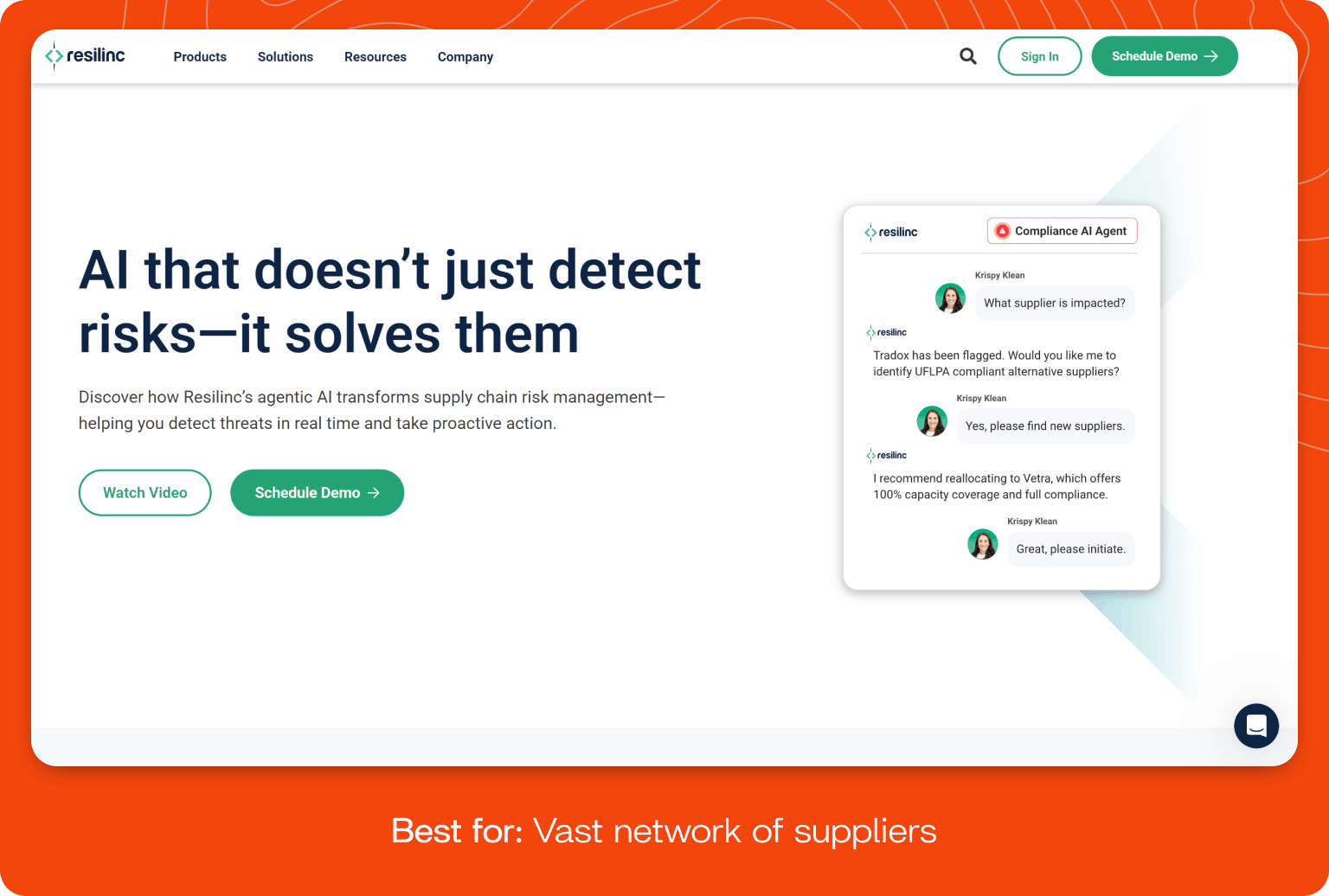
Best for: Vast network of suppliers
Resilinc supports risk management through its conversational, agentic AI platform and large, detailed supplier network information.
Resilinc’s global network of more than 150 thousand suppliers helps customers gain visibility into established supply bases. It sorts these suppliers using an R Score® (Resilience score) to automatically rank them based on performance, transparency, supply continuity, and the maturity of their risk program. These scores shift in near real time in response to changing risk factors.
User reviews on Gartner speak positively about how useful the EventWatch risk notification tool is. EventWatch works alongside RiskShield to help quantify revenue or supply chain impacts, enabling users to make more informed decisions. However, some reviewers have found the tool complex to use, with one needing to extract data manually.
Key features:
- SC Watch, Monitor, and Command: Resilinc’s Supply Chain (SC) Watch, Monitor, and Command tools provide real-time notifications of global events, support proactive risk management, and enable what-if simulations for different potential events.
- Scenario-specific AI agents: Customized AI agents can help you identify and respond to supply chain disruptions that include upcoming tariffs, UFLPA audit risks, and geopolitical risks.
- EventWatch: Notifies you of global events that may affect your supply chain, using more than 104 million sources, including global news and weather stations.
- RiskShield: Connects government, environmental, and economic risks to quantifiable revenue impacts to help you understand where to focus your mitigation.
Pricing: Contact for pricing.
3. Exiger
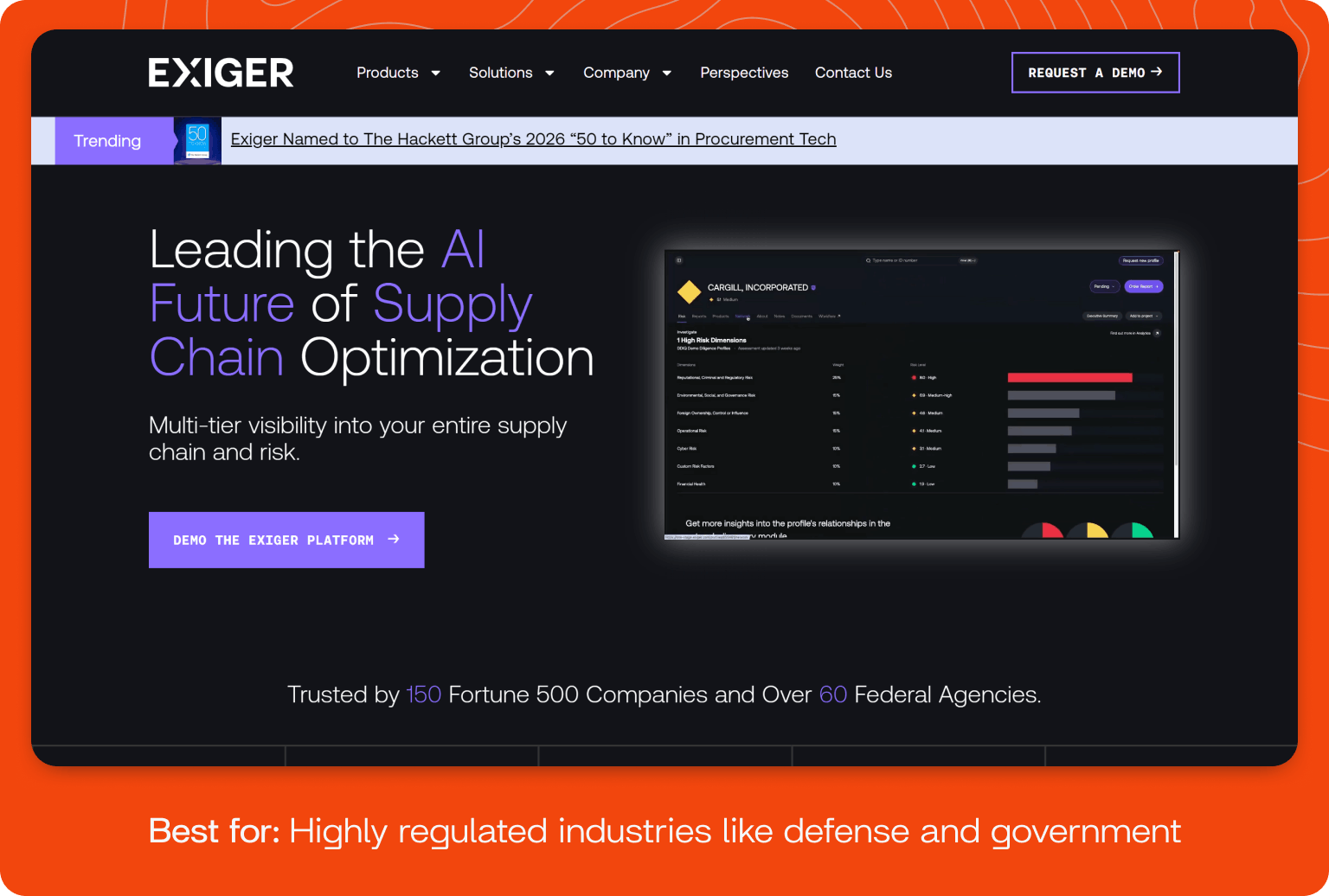
Best for: Highly regulated industries like defense and government
Exiger helps optimize cost, speed, and sustainable business practices while providing risk insight tools through its online platform, Exiger1.
Exiger uses industry-specific tools for government agencies and defense contractors. For instance, the company’s supply chain mapping tools can reduce agency risk in adversarial countries by finding alternative providers in nearby countries without conflict. It also breaks down product sourcing by different parts, such as OSHA (Occupational Safety and Health Administration) requirements for proper insulation when using electrical equipment.
User reviews on G2 and Gartner are mostly positive, highlighting its simple user interface and effective support team. However, some have found the platform is less accessible on mobile devices. Others have found the platform slow, especially while processing large amounts of data.
Key features:
- Proactive Intelligence platform: Relies on predictive intelligence based on historical supplier data and current events to keep users informed.
- Supply chain optimization: The 1Exiger platform helps reduce costs and improve efficiency by highlighting negative environmental or efficiency impacts, including supply continuity, emissions levels, and lead times.
- UBO identification: Identifies a supplier’s UBO (Ultimate Beneficial Owner) to help customers research their history and find out if they’re a risky collaborator.
- Supply chain security: Analyzes a bill of materials (BOM) to identify counterfeit parts, countries of origin (COO), and similar vulnerabilities.
Pricing: Contact for pricing
4. Everstream Analytics
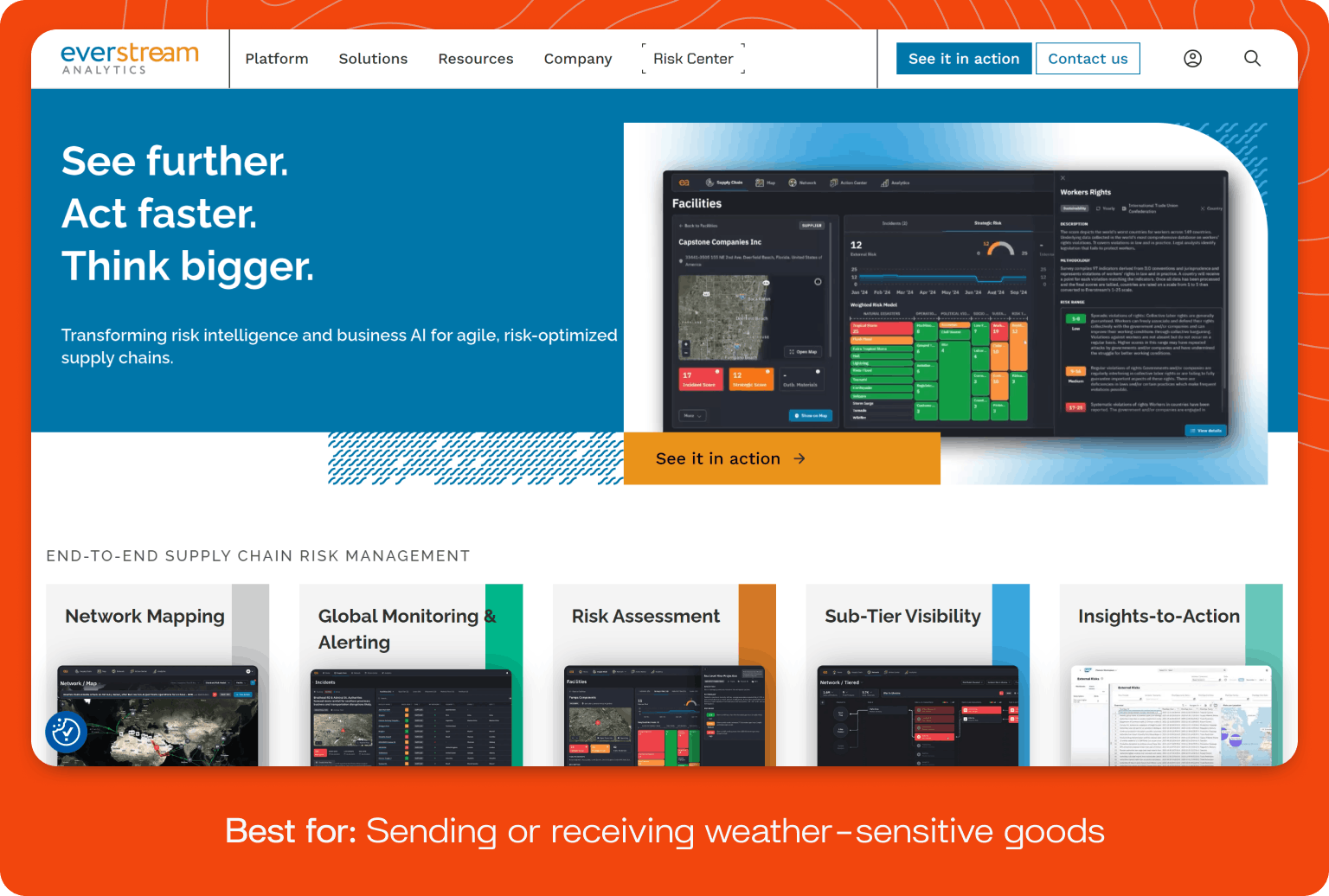
Best for: Sending or receiving weather-sensitive goods
Everstream Analytics provides global network mapping, monitoring, and assessments to identify potential risks. The company even employs a dedicated meteorological team to forecast how weather and temperature changes could affect your supply chain.
The company uses digital twins, or copies of its supplier network, to discover and highlight potential risks using two different tools. Everstream Reveal monitors for global natural disasters and geopolitical events. Meanwhile, Everstream Discover reviews multiple supplier tiers to identify risks from sourcing through receiving.
Looking at Gartner user reviews, customers appreciate the depth of information on suppliers and risks. However, some reviewers are critical of the company’s dependence on human interpretation, while competing platforms may be more likely to translate data into actionable decisions.
Key features:
- Network mapping: Enables creation of a digital twin that integrates with planning, procurement, and logistical tools to help identify risks.
- Risk assessment: Relies on simple scorecards to assess supplier vulnerability and its potential impact on a company’s long-term success.
- Insights to action: Uses real-time risk analysis that directly links with some planning systems through API (Application Programming Interface) integrations.
- Global monitoring and alerts: Provides global event monitoring with access to paywalled content vetted by human experts to help notify you of risks and limit false positives.
Pricing: Contact for pricing.
5. Interos
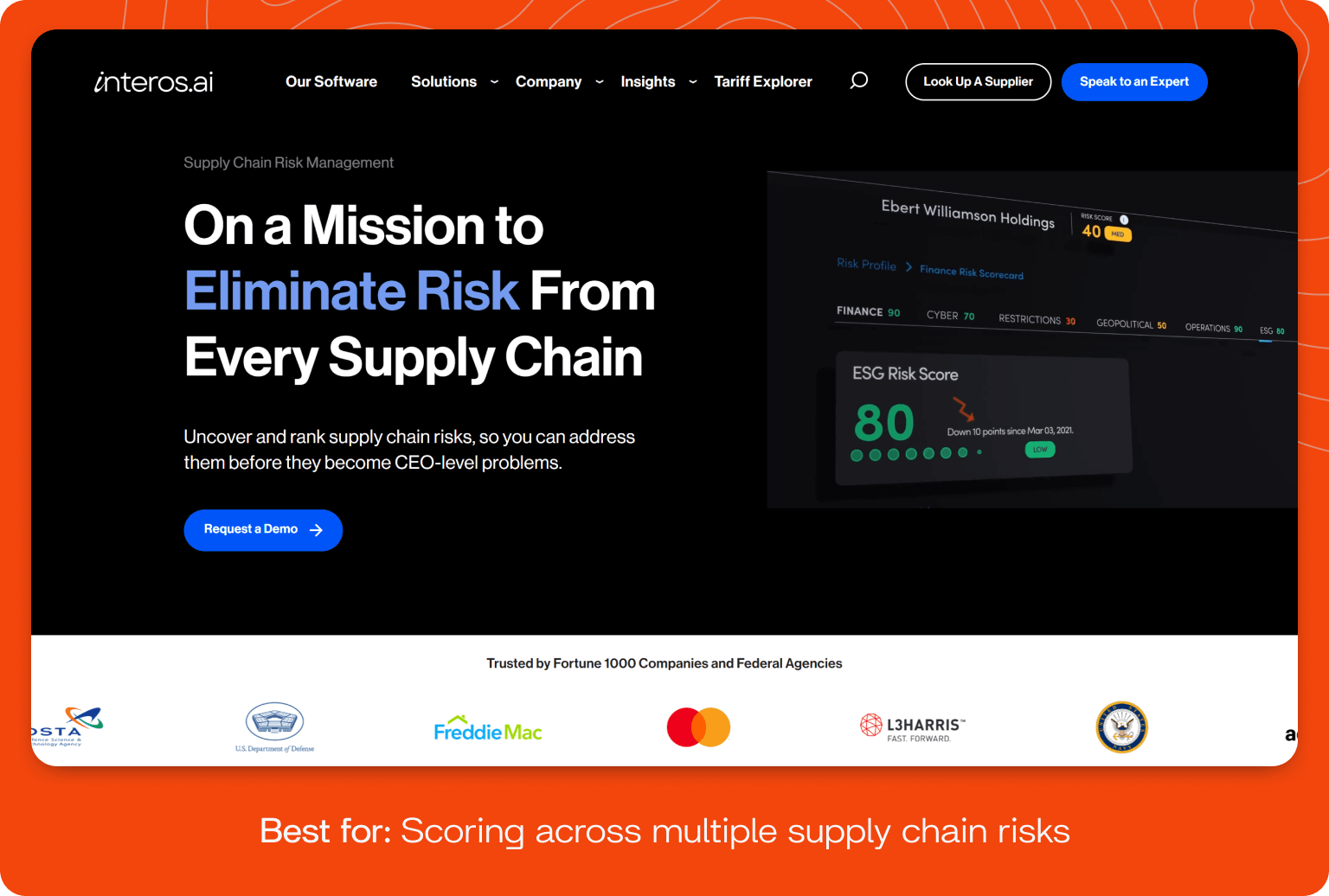
Best for: Scoring across multiple supply chain risks
Interos provides tools that help companies visualize risks with a network of over 11 billion supply chain relationships. It provides supplier risk scoring across numerous dimensions, allowing customers to source where the risks are coming from.
The Interos i-Score system assesses risks based on financial weaknesses, regulatory compliance, natural disasters, cybersecurity, operational problems, and geopolitical issues. These dimensions dig into relationships by evaluating multi-tier supply chains to uncover hidden risks.
Despite Interos’s 2005 founding, it has few customer reviews.
Key features:
- Cyber vulnerability exposure: Identifies suppliers with weak cybersecurity practices to help protect data integrity.
- Similar Suppliers: Provides supplier alternatives to address supply chain volatility driven by issues such as tariffs or geopolitical risks.
- Catastrophic risk visualizer: Provides a world map of catastrophic risks with up to 48 hours' advanced notice of vulnerabilities.
Pricing: Contact for pricing.
6. Coupa
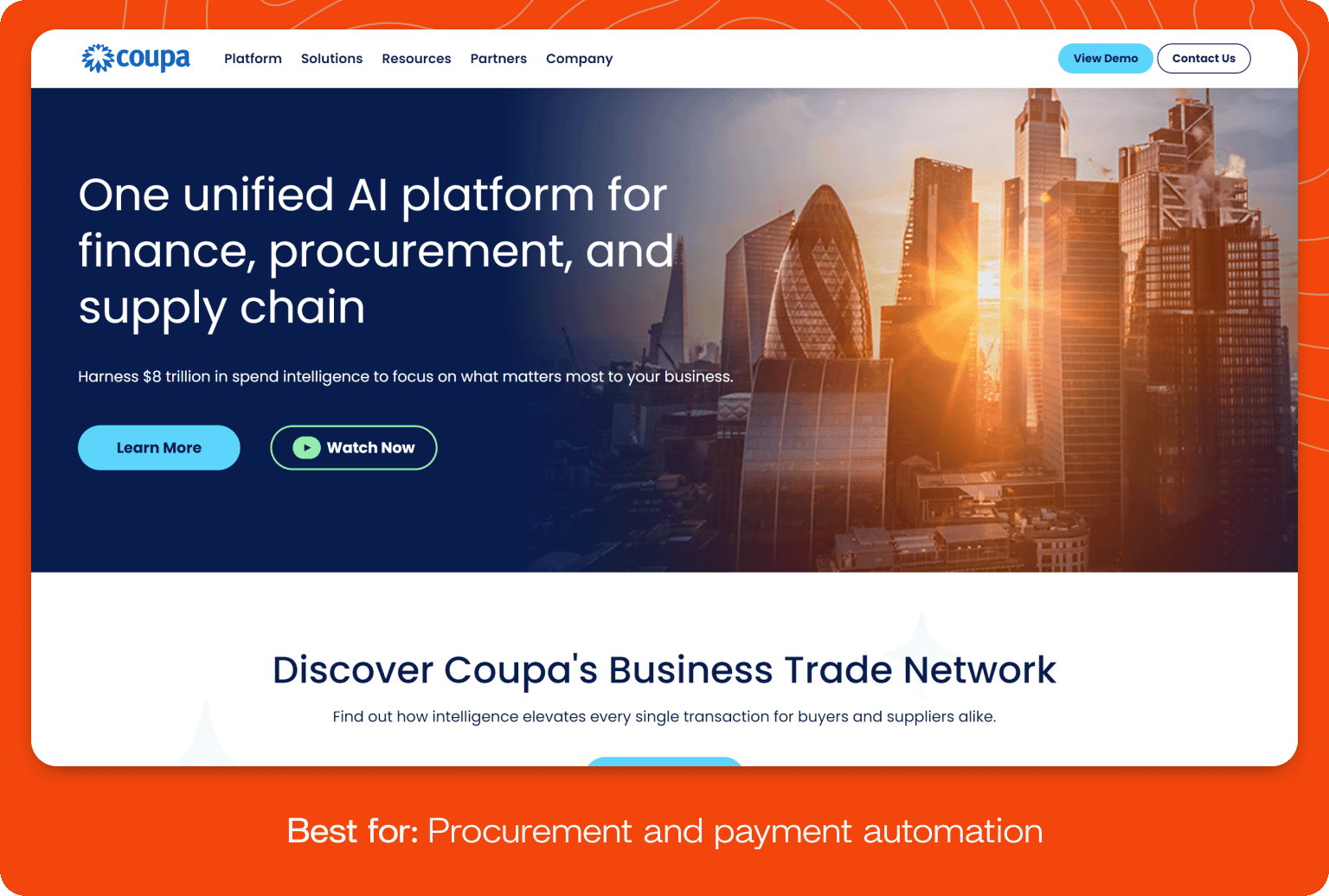
Best for: Procurement and payment automation
Coupa uses a blend of cross-community data and user feedback to benchmark performance and optimize supply chains for mid-market and enterprise organizations. The company focuses its risk mitigation efforts on procurement and payment, so companies can focus elsewhere.
While the company supports ESG compliance, this feature takes a backseat to its Procure-to-Pay tools. It integrates with procurement workflows to identify potential savings and feature high-rated suppliers. Coupa provides an online marketplace and communication platform to help connect verified suppliers with the right businesses.
According to user reviews on Software Advice, customers appreciate how it streamlines the payment process and helps track expenses. However, other reviewers have shared that the supplier portal was hard to navigate and could lead to invoicing errors. Organizations looking for pure supply chain risk software should consider alternatives.
Key features:
- Supply chain scenario building: Relies on digital twin technology to build scenarios for different potential supplier collaborations.
- Procurement assistance: Assists with sourcing high-quality providers, inventory management, and expense analysis.
- AP automation: Automates invoice creation to simplify payment requests and tracks expenses to help with tax compliance.
Pricing: Contact for pricing.
7. Sphera
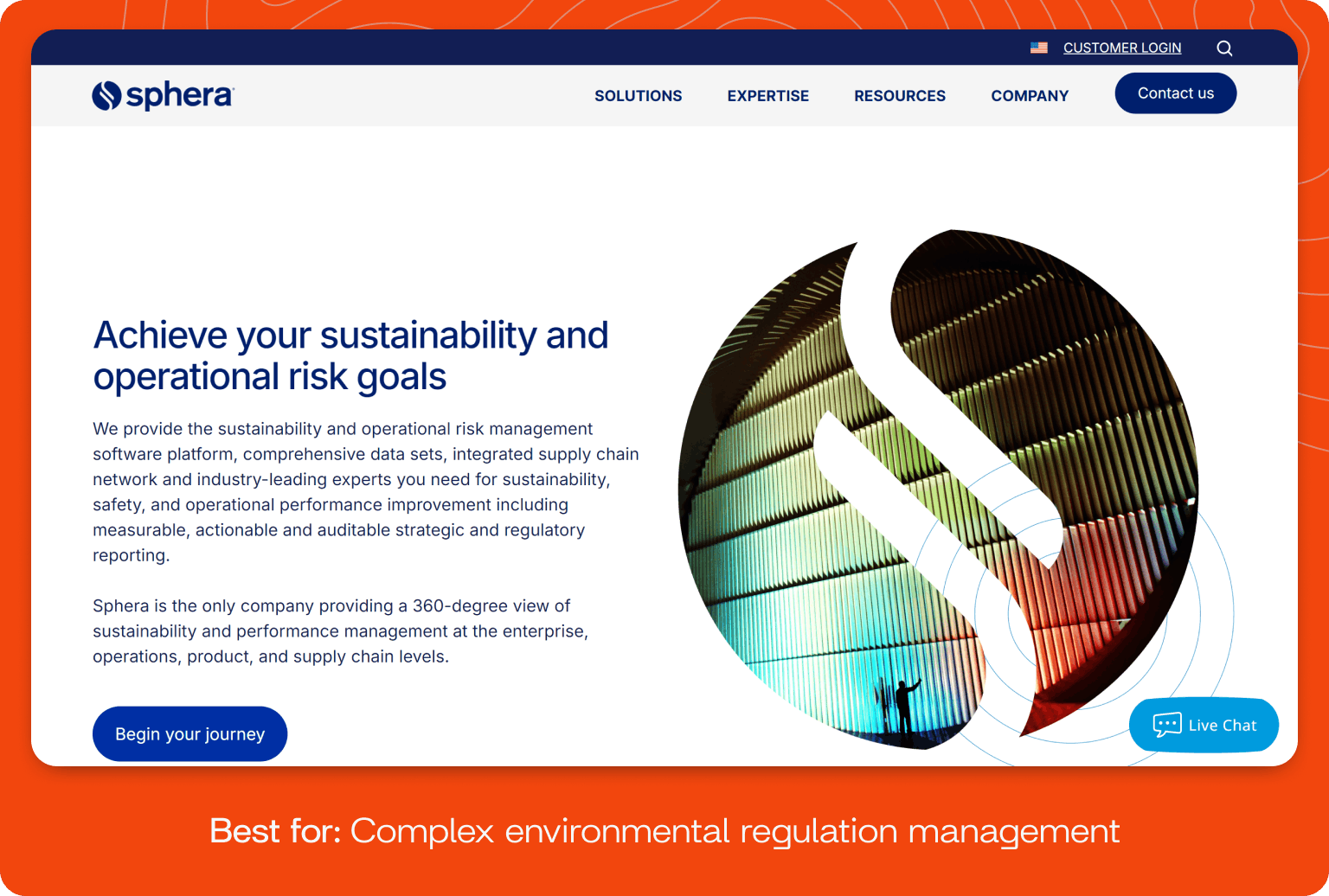
Best for: Complex environmental regulation management
Sphera provides ESG compliance support with a strong emphasis on sustainability for enterprise companies. It works with over 2,800 companies to track and produce sustainability reports that meet ever-changing environmental and regulatory requirements.
It provides a wide variety of tools to help identify and mitigate internal and external risks. On the inside, it’s corporate sustainability software that tracks, stores, and helps create auditable reports to meet regulatory standards. On the inside, Sphera’s health and safety tools help identify internal risks to keep your operations moving and people safe.
Looking at reviews on Gartner and G2, some customers have found that Sphera can sometimes lag, potentially due to server-side issues. Other reviewers have found that uploading first-party data and sharing information can feel tedious.
Key features:
- Environment, Health, Safety & Sustainability (EHS&S): Reviews a wide range of human capital and environmental impacts to meet global safety standards and protect employees from internal risks (such as hazardous materials exposure).
- Life Cycle Assessment (LCA) Automation: Reviews and forecasts product lifecycles and their potential environmental impact with TÜV-certified capabilities to meet international safety, quality, and sustainability standards.
- Process Hazard Analysis (PHA): Sphera’s PHA-Pro tool identifies potential safety improvements when working with hazardous chemicals.
Pricing: Contact for pricing.
8. Z2Data
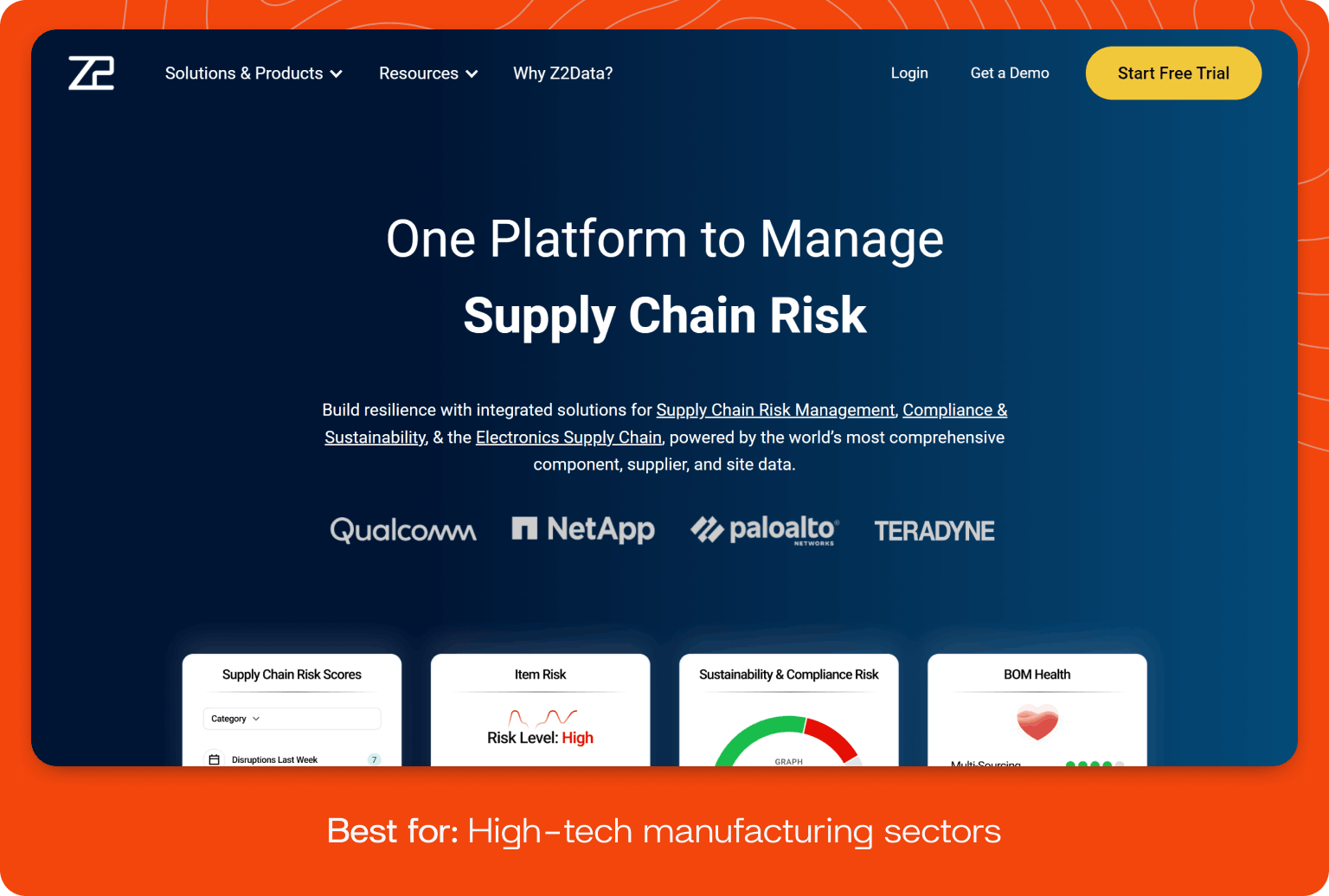
Best for: High-tech manufacturing sectors
Z2Data specializes in providing part-level supply chain risk management for high-tech manufacturing industries. It manages a company’s Bill of Materials (BOMs) to support the long-term health of product lines by addressing technical risks like component obsolescence and compliance failures.
The company tracks over one billion electronic components using predictive algorithms and lifecycle forecasts to mitigate end-of-life (EOL) risks before they impact protection. It also compares BOMs against over 105 regulatory standards, including the EU’s Restriction of Hazardous Substances (RoHS) directive, which limits materials like lead or mercury in manufacturing.
Key features:
- Compliance manager: Provides full material declarations (FMDs) and checks those materials against global regulations to discover where they may be banned.
- Product Change Notification (PCN) manager: Reviews thousands of equipment and material providers for changes to supplier BOMs that may affect regulations.
- Tariff watch and trade compliance: Calculates potential tariff impacts based on a part’s country of origin to better understand import cost impacts.
Pricing: Contact for pricing.
Key Features to Look For in SCRM Software
Good SCRM software goes beyond surface-level details, delving into layered supply chain risks. While the user interface should start with a simple score, data should be transparent and provide clarity when tracking ESG standards, supplier stability, and geopolitical disruptions.
Here’s what you should keep in mind:
- Regulatory reporting automation: Platforms should review your supplier relationships and documentation to identify risky situations and assessment process gaps. This could include missing regulatory information or suppliers known for violations, such as suppliers that share large amounts of sensitive personal data with some countries under the DOJ’s Bulk Transfer Rule.
- N-Tier visibility: Highlights supplier risks hidden beneath surface-level relationships to identify ethical and compliance violations, such as raw materials sourced from companies in the Xinjiang province that are banned under the UFLPA.
- Supplier benchmarking: Supplier risk assessments should support the quick identification of reliable suppliers using a simple score, so business leaders can determine whether they’re trustworthy without digging through news articles.
- Real-time alerts: Platforms should monitor and alert you of relevant ESG events that impact your organization, and provide alternative suppliers (and an action plan to switch) should the risk become too great.
- Agentic AI: Providers should rely on agentic AI and independently create action plans to support quick decisions, as delays could lead to further disruptions or financial losses.
- ESG and compliance assistance: AI tools should track evolving government regulations and compare recent changes to a company’s documentation to manage environmental, social, and governance risks.
- Integration with existing platforms: Effective supply chain management tools integrate with your existing tools to simplify automatic information tracking. Example integrations include SAP, Oracle, Jira, and Google Cloud.
- Centralized dashboards: A centralized dashboard should be simple and customizable to support your company’s unique information needs.
Build Verifiable Resilience with Tradeverifyd
The right supply chain risk software moves companies beyond reactive firefighting, enabling them to make proactive decisions based on verifiable supplier resilience. Through n-tier visibility and awareness of regulatory threats, your business stays compliant, even amid complex environmental and geopolitical challenges.
Tradeverifyd turns messy supply chain data into clear, actionable intelligence. Where other tools work well for specific niches, Tradeverifyd stands out through verifiable data sources and regulatory certainty, using a simple conversational AI interface to plan for risks and keep operations moving. Book a demo today to see how your team can benefit from simplified compliance, risk monitoring, and visibility at scale.