Tradeverifyd Names Amanda Greene Chief Operating Officer to Lead Next Phase of Scale
Former Airbnb and Oyster HR operations leader brings two decades of experience scaling AI-enabled, high-growth companies


Blog >
Supply Chain
The Tradeverifyd Team

Global semiconductor sales are projected to reach $760.7 billion in 2026, underscoring the industry's massive scale and the urgency of its supply chain challenges. Companies are navigating limited visibility, manual processes, and external pressures like tariffs and geopolitical uncertainty, making effective semiconductor supply chain management more critical than ever.
To understand how organizations are addressing these pressures, Tradeverifyd surveyed 317 U.S. supply chain and logistics professionals at companies that produce, use, or purchase semiconductors.
The results reveal an industry balancing immediate operational gaps with strategic investments in supply chain visibility, predictive insights, and automated processes to better anticipate disruptions.
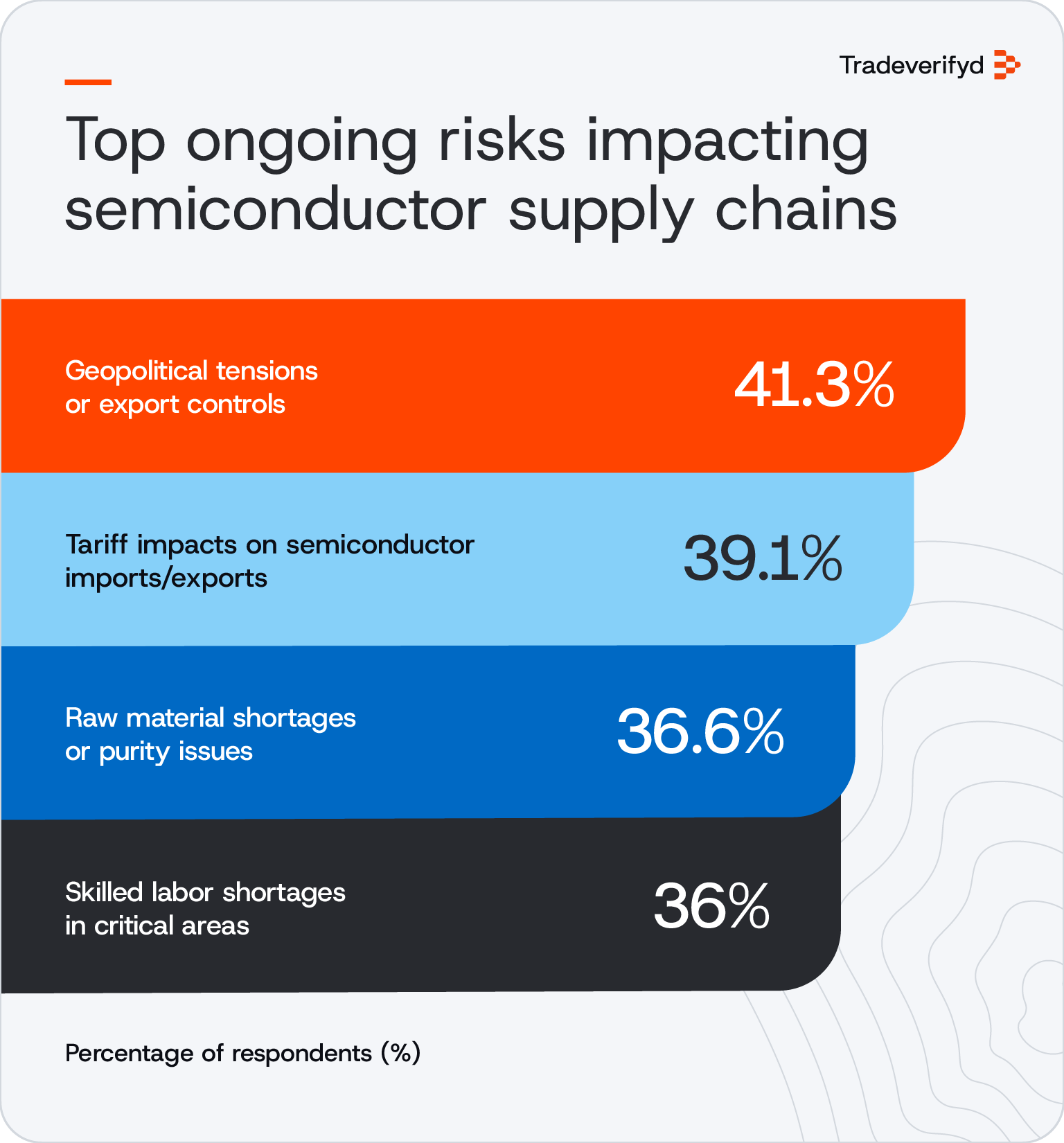
External pressures remain the most pressing concern for semiconductor supply chain professionals: 41.3% cite geopolitical tensions and export controls, while 39.1% point to tariff impacts. At the same time, internal constraints such as raw material shortages (36.6%) and skilled labor gaps (36%) add another layer of risk.
Cost pressures are a particularly acute challenge: 57.4% of suppliers identify tariffs and component costs as their biggest sourcing concern — roughly 10% higher than the next issue, supplier reliability (47.9%). Inventory shortages (47.6%) also loom large, underscoring the financial strain tariffs are placing on organizations and the critical need to manage cost impacts proactively.
“In today's trade environment, tariffs and export controls are operational concerns as much as regulatory concerns. The semiconductor sector lives and dies by where its suppliers sit, both geographically and politically. When you can trace exposure across every tier of your network, you move from managing compliance to managing performance. That’s the visibility enterprises need to keep production predictable.”
— Karyl Fowler, Chief Policy Officer at Tradeverifyd
The real differentiator for future-proofing operations is measuring financial and compliance exposure across every tier of the supply base. Leaders must adopt solutions that provide multi-tier mapping combined with compliance-ready supplier profiles.
Tradeverifyd helps firms map supplier exposure to tariffs and export controls, transforming external risks into actionable insights. Risk isn’t the tariff itself — it’s not knowing where it will hit your global supply chain map.
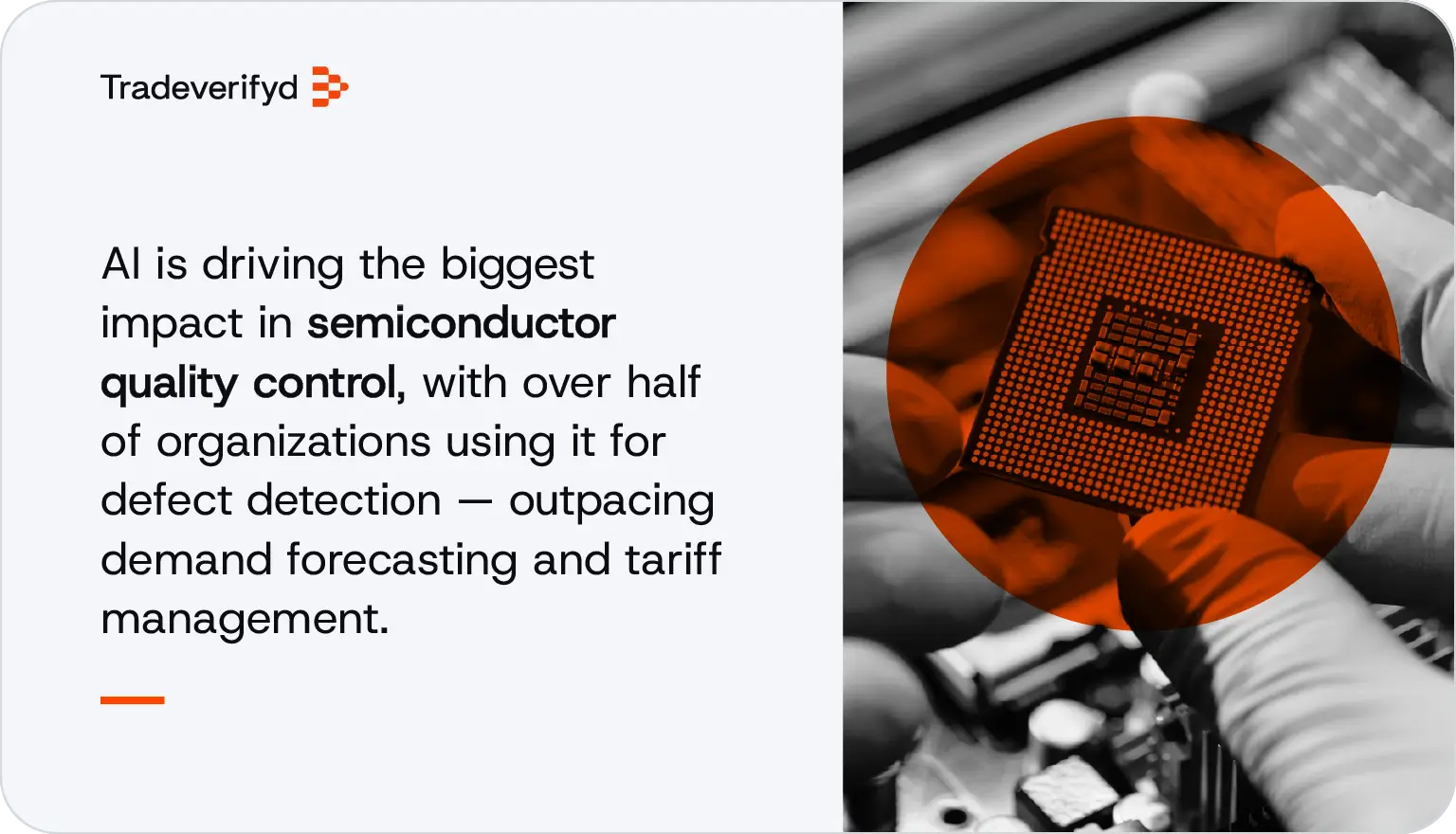
Artificial intelligence is already a fixture in semiconductor supply chain map operations, with 52.4% of respondents using it for quality control (QC) and defect detection. While AI in QC is mature and highly valuable, it’s not the frontier of what the technology can offer the supply chain. AI’s untapped value lies in its potential for predictive risk modeling.
Moving AI beyond the factory floor requires combining open-source intelligence (OSINT) with verified, deep-tier supplier data. Tradeverifyd specializes in this approach, leveraging its autonomous AI to analyze real-time OSINT against a client's unique multi-tier supplier map.
This verified data unlocks predictive value that can anticipate supplier disruptions or compliance gaps, shifting the business from reactive firefighting to proactive resilience.
Despite the focus on external supply-side risks, the most critical visibility gap is on the demand side. Customer demand forecasts rank last in visibility (2.8/5), and only 17.7% of companies report being extremely confident in their visibility into Tier 2-3 suppliers. The industry’s core vulnerability is clear: Demand is volatile and external, but supply readiness is controllable.
The solution is deep multi-tier visibility paired with compliance-ready supplier profiles. Tradeverifyid equips leaders to identify which suppliers can flex capacity, which are at risk, and how disruptions could cascade upstream. You can’t predict demand, but you can control how prepared your supply base is to meet it.

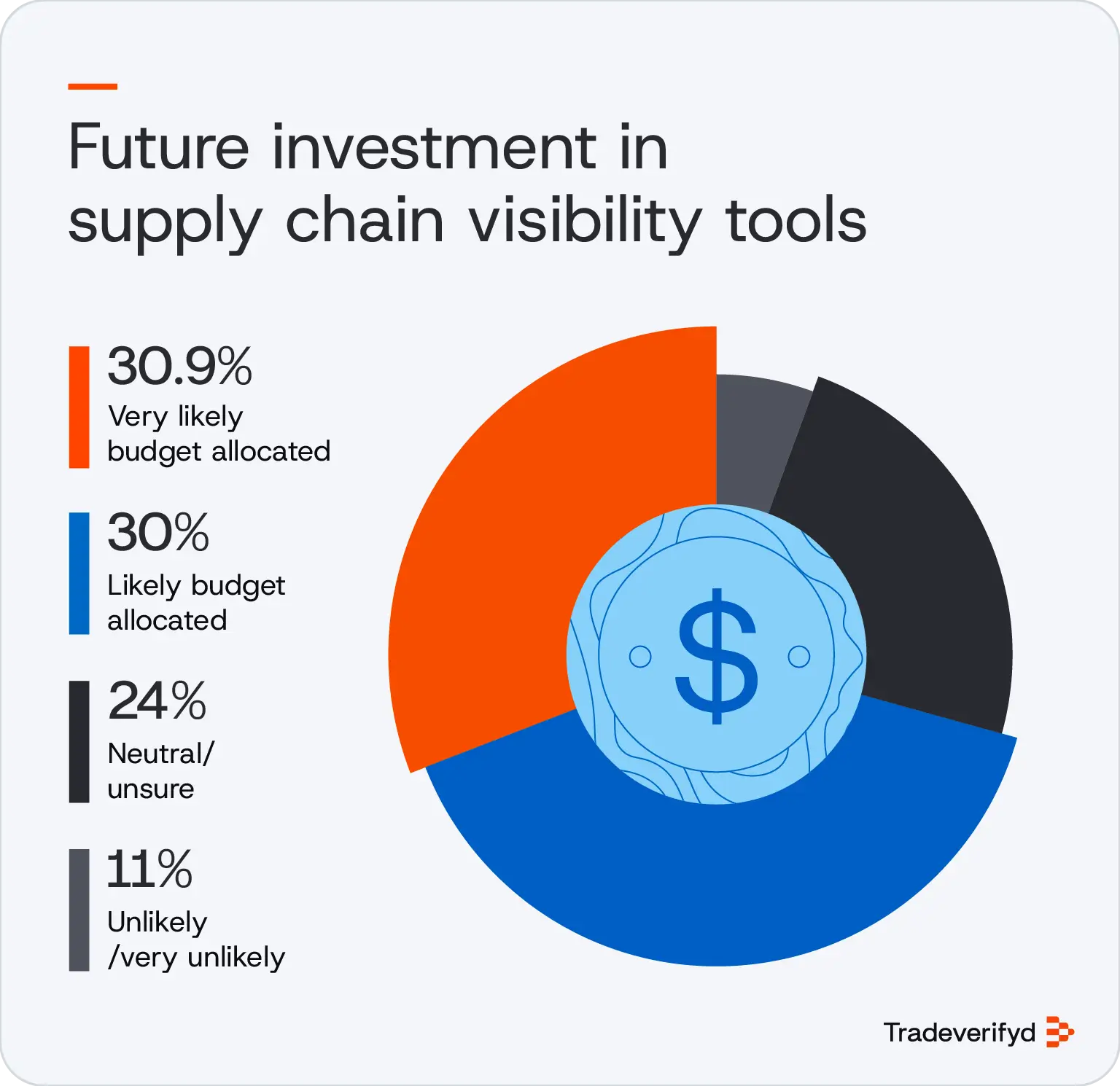
The desire to upgrade visibility tools is strong, with 70.6% of suppliers saying they are likely or very likely to invest. However, the dominant strategic priority for these investments is cost reduction and efficiency (35.3%).
This reflects a common pattern: Digital investments often begin with internal efficiency, but the same tools can enable agility, resiliency, and risk management when applied strategically.
These investments in visibility are an essential step, but they must be positioned as strategic assets to enable efficiency and future agility.
“Adaptability drives stronger capital outcomes. When supply chains can flex with demand, leaders don’t overbuild capacity or tie up cash in excess inventory. In this context, visibility offers more than just operational clarity. It also enables financial control at scale, with that discipline showing up directly in CapEx efficiency and EBITDA performance."
— Mike Prorock, Tradeverifyd Founder & CEO
A significant portion of respondents (46%) still rely on manual processes or spreadsheets to track supply chain risks, with 10.1% reporting no structured monitoring. This presents a real opportunity: By moving to automated, end-to-end monitoring, companies can gain faster, more accurate insight into their supply chains.
In today’s complex, high-volume, and rapidly changing semiconductor environment, manual monitoring simply isn’t realistic. Continuous monitoring is today’s minimum standard — it allows leaders to stay ahead of disruptions, respond quickly to market shifts, and make smarter, data-driven decisions.
But adopting automated visibility isn’t just about replacing spreadsheets; it’s about giving your team the tools to confidently manage risk and build a more resilient, future-ready supply chain.
Tradeverifyd enables organizations to map supplier exposure, track multi-tier risks, and turn complex data into actionable insights, making proactive risk management a reality.

Our survey paints a picture of an industry at an inflection point. Tactical investments in efficiency are necessary but insufficient for navigating today’s geopolitical and demand volatility. To build a resilient, future-ready supply chain, you need to:
Priorities for supply chain management in the semiconductor industry must shift to holistic, data-driven resiliency.
“In semiconductor supply chains, risk moves faster than reporting cycles. Automation isn’t about replacing oversight; it’s about keeping pace with it. When monitoring is continuous and supplier data is verifiable to its source, leaders can spot disruptions early, stay compliant across markets, and protect capacity before it’s at risk.”
— Karyl Fowler, Chief Policy Officer at Tradeverifyd
Managing supply chain risks can feel overwhelming, but high-tech firms don’t have to do it alone. Clear visibility, reliable data, and ongoing monitoring make all the difference.
Tradeverifyd helps you see exactly where your suppliers stand, understand potential risks, and stay compliant across your supply base.
Curious how it works? Request a demo and discover how Tradeverifyd can turn uncertainty into confidence for your supply chain.
The survey was conducted via Centiment Audience for Tradeverifyd and fielded on September 12, 2025. Results are based on 317 completed surveys. To qualify, respondents had to be U.S. residents over the age of 18. All participants held roles or responsibilities that include supply chain or logistics at organizations that produce, use, or purchase semiconductors.
Resources & Insights
+
02